Skip to main content
  Add Elite Elevators as preferred


Table of Contents
When choosing a home lift, capacity is about more than simply asking, “How many people can fit inside?” A cabin that feels cramped during everyday use can make travelling between floors less comfortable, particularly when family members are carrying shopping bags, travelling with children, or assisting an elderly person. Choosing the right capacity from the beginning can make a noticeable difference to the lift’s practicality.
The number of people a lift can accommodate depends on its rated load, cabin dimensions, design, and intended use. While some compact residential home lifts are designed for a few passengers, larger models can provide more space for families or wheelchair users. Understanding these differences is essential when comparing a residential elevator for a multi-storey home.
A home elevator should provide enough room for its intended users without choosing a cabin that is unnecessarily large for the available space. In this guide, we explore how passenger capacity is determined, what affects comfort inside the cabin, and how homeowners can choose a suitable lift size based on their family’s everyday needs.
What Are The Specifications To Choose Residential Home Lifts From Elite Elevators?
A residential elevator stops for whichever limit it reaches first, and that is rarely the one buyers focus on.
The weight limit: Rated load is the certified maximum a lift is designed and tested to carry. Every component — drive, chains, brakes, guide rails — is sized around it. Across the Elite Elevators range this is 400 kg on the E200, E300 and X200 series and 440 kg on the X400 range.
Converting weight to passengers requires an assumed average. At 80 kg per adult, 400 kg gives five people. At a more realistic Malaysian adult average of 65–70 kg across mixed ages, the same 400 kg gives six. But neither figure matters if the passengers can’t physically stand comfortably.
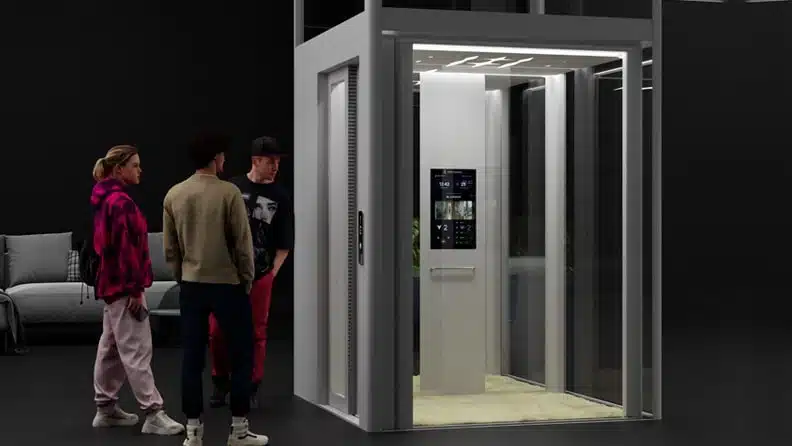
The floor area limit: This is what determines comfort, and it’s why cabin dimensions belong on your shortlist alongside rated load. Standard cabins across the range include 1400 × 1200 mm on the X200 Plus, 1200 × 1200 mm on the X400 Mark Ⅱ, and an XL option of 1500 × 1500 mm — described as the world’s largest cabin in its category. The E200 is available in eight standard sizes or built to custom dimensions.
A useful planning figure: comfortable standing space in a lift is roughly 0.2 m² per person. A 1400 × 1200 mm cabin gives 1.68 m² — comfortably for four adults, five at a squeeze. The 1500 × 1500 mm XL cabin gives 2.25 m², which is where genuine five-passenger comfort begins.
The practical conclusion: on most residential home lifts, floor area runs out before weight does. A cabin rated at 400 kg will feel full at four adults long before the load sensor objects.
What Is The Passenger Capacity Across the Elite Elevators Range?
| Model | Rated load | Standard cabin size | Comfortable capacity | Maximum capacity | Best suited to |
| E200 | Up to 400 kg | Eight standard sizes or custom | 3–4 adults | Up to 5 persons | Families wanting cabin sized to an existing void |
| E300 CogBelt | Up to 400 kg | Customisable, RAL and glass variants | 3–4 adults | Up to 5 persons | Villas needing travel to 18,000 mm |
| X200 | 400 kg | Compact, space-efficient structure | 3 adults | Up to 5 persons | Compact homes, retrofit projects |
| X200 Plus | 400 kg | 1400 × 1200 mm | 4 adults | Up to 5 persons | Everyday family use with luggage |
| X400 | 440 kg | Up to 1500 × 1500 mm | 4–5 adults | 5–6 persons | Multi-generational households |
| X400 Mark Ⅱ | 440 kg | Std 1200 × 1200 mm / XL 1500 × 1500 mm | 4 adults (std) / 5 adults (XL) | 5–6 persons | Homes wanting maximum cabin area |
Comfortable capacity assumes adults standing without contact, with room to reach the control panel. Maximum capacity reflects the rated load at an 80 kg average.
What Kind Of Home Lift Elevator Is Best For Your Household?
Capacity is rarely about the theoretical maximum. It’s about the two or three scenarios that recur weekly.
- This is the scenario that most often dictates cabin size, and it needs depth rather than headcount. A wheelchair user plus a carer standing beside them requires roughly 1400 mm of clear depth — which is precisely why the 1400 × 1200 mm configuration exists.
- A parent with a young child and a pram counts as two passengers, but they occupy space closer to three.
- Weight is seldom the issue; a full shopping load rarely exceeds 30 kg. Floor space is. Two adults plus four shopping bags fill a 1200 × 1200 mm cabin quickly.
- Moving furniture is occasional but critical. Depth and door width matter more than load here; door openings across the hydraulic range run 600–900 mm, and the E200 supports up to 12 doors per lift across a maximum of 6 stops.
- Emergency access is worth thinking about once. If a stretcher may ever need to reach an upper floor, the 1500 × 1500 mm XL cabin is the only configuration in the range that approaches it.
How Does A Certified Residential Elevator Handle Safety During Travel?
The X400 range includes a smart overload detector; the X200 series uses load sensors with overload alerts; and the E200 includes overload protection that prevents operation when weight exceeds the safe limit. In every case the lift withholds the start command, doors remain open, and passengers are notified — so someone simply steps out. There is no partial trip, no stalling between floors.
This sits within a wider certified framework. The E200 and E300 comply with the European Machinery Directive 2006/42/EC, and are certified to EN 81-41. The X400 Mark Ⅱ meets EN 81-20 and EN 81-50 with dual emergency braking within a 5-layer safety framework.
Every model also provides for power failure: battery-operated emergency lowering on the E Series with cabin light and fan backup, and an Automatic Rescue Device with GSM emergency calling across the X series — bringing the cabin to a floor where passengers exit safely regardless of how many are aboard.
Frequently Asked Questions
-
How many people can fit in a residential elevator?
It depends on rated load and cabin area. Elite Elevators residential home lifts carry 400 kg on the E200, E300 and X200 series — approximately five passengers at an 80 kg average — and 440 kg on the X400 range. In practice, four adults is the comfortable figure for a 1400 × 1200 mm cabin, with five suited to the 1500 × 1500 mm XL configuration.
-
What is the weight capacity of a home lift elevator?
The Elite Elevators E200, E300, X200 and X200 Plus are all rated to 400 kg, while the X400 and X400 Mark Ⅱ carry 440 kg with smart overload detection. These figures are certified under EN 81-41, the European standard for vertical lifts in private residences.
-
What is the smallest cabin size that still fits a wheelchair and a carer?
A cabin of 1400 × 1200 mm — the standard configuration on the Elite Elevators X200 Plus — provides the depth for a wheelchair user with a carer standing alongside. For larger wheelchairs or stretcher access, the 1500 × 1500 mm XL cabin on the X400 range offers the greatest area available.
-
What happens if too many people get into a home lift?
The lift will not start. Elite Elevators models use overload protection, load sensors and overload alerts to detect excess weight while stationary, keeping doors open and notifying passengers until the load is reduced. The lift never attempts a partial journey.
-
Can cabin size be customised to suit a specific space?
Yes. The Elite Elevators E200 is available in eight standard sizes or built to custom dimensions, and the E300 offers customisable RAL and glass variants. Both can be supplied with a patented self-supporting metallic shaft, making them suitable for retrofitting into existing homes with minimal civil work.