Skip to main content
  Add Elite Elevators as preferred


Table of Contents
- What Are The Limits That Govern a Multi-Stop Household Elevator Installation?
- What Are The Matching Household Lifts From Elite Elevators To The Number Of Levels?
- Why Does Drive Type Of Household Lifts Matters More As Stops Increase?
- What Builds the Shaft For Multiple Stops In Domestic Lifts With Elite Elevators?
- Frequently Asked Questions
A multi-storey home can offer more space and flexibility, but moving between several levels can become challenging when stairs are the only option. For an older family member, someone using a wheelchair, or a person recovering from an injury, climbing stairs multiple times a day may be uncomfortable or impractical. A lift that can serve several floors can make the entire home easier to navigate.
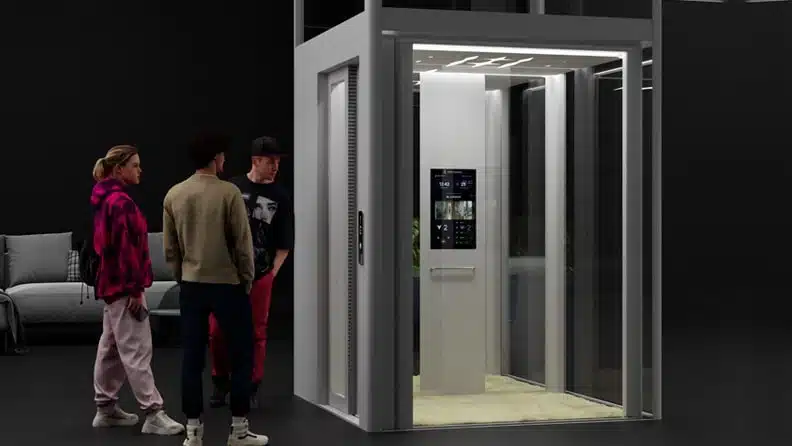
A household elevator with multiple stops is designed to connect different levels within a residence, allowing passengers to travel directly between designated floors. For families exploring accessibility solutions, options may include wheelchair lifts and wheelchair friendly elevators, depending on the home’s layout, cabin requirements and mobility needs. In some properties, a stair elevator may also be considered when installing a full lift is not practical.
Choosing the right solution requires more than simply counting the number of floors. Homeowners should consider available space, cabin dimensions, accessibility requirements, stopping points, installation conditions, safety features and long-term maintenance. This guide explores how multi-stop household elevators work and what to consider when selecting a solution for a multi-level home.
What Are The Limits That Govern a Multi-Stop Household Elevator Installation?
Most buyers focus on stop count alone. It’s the least binding of the three.
Travel height is usually what runs out first. This is the total vertical distance from the lowest landing to the highest, and it accumulates faster than people expect. A typical Malaysian floor-to-floor height of around 3,200 mm across five levels gives roughly 12,800 mm of travel — already at the ceiling of what a hydraulic lift handles. Add a high ground-floor volume or a basement and you have moved into gearless territory whether you intended to or not.
Stop count determines shaft complexity. Each stop needs a landing door, an interlock, a call station and a precisely positioned opening in the structure. Six stops means six sets of everything, aligned vertically through the building.
Door count is separate from stop count — and often overlooked. A single stop can have two doors where landings sit on opposite faces of the shaft, which is common in homes where the ground floor opens to a porch on one side and a living area on the other. The Elite Elevators E200, E300 and X400 Mark Ⅱ each support up to 12 doors per lift, which allows through-car access at every stop on a six-stop installation.
What Are The Matching Household Lifts From Elite Elevators To The Number Of Levels?
The specifications help the functionality of household lifts to be better. They are as follows:
| Specification | E200 | E300 CogBelt | X200 / X200 Plus | X400 Mark Ⅱ |
| Maximum stops | 6 | 6 | Up to 4 (G+4) | Up to G+5 |
| Maximum doors | 12 | 12 | Per stops served | 12 |
| Travel height | 12,600 – 13,100 mm | Up to 18,000 mm | Site dependent | Up to 21,000 mm |
| Drive system | Hydraulic control unit, indirect action by chains | Patented gearless CogBelt | Hydraulic chain drive | Gearless belt drive |
| Rated speed | 0.15 – 0.3 m/s | 0.15 – 0.4 m/s | Up to 0.30 m/s | Up to 1.0 m/s |
| Rated load | Up to 400 kg | Up to 400 kg | 400 kg | 440 kg |
| Certification | 2006/42/EC, EN 81-41 | 2006/42/EC, EN 81-41 | EN 81-41 | EN 81-20, EN 81-50 |
Why Does Drive Type Of Household Lifts Matters More As Stops Increase?
This is the part that separates a lift that works on paper from one your family actually enjoys using.
Hydraulic drive: The E200’s hydraulic control unit with indirect chain action runs at 0.15–0.3 m/s — smooth, quiet, and entirely adequate over three or four stops. It operates on a single-phase power supply with 24 V control, consuming roughly what a half-ton air conditioner does, which keeps running costs low for a lift used many times daily.
Journey time: At 0.30 m/s, travelling 13,000 mm takes around 43 seconds before doors. At 1.0 m/s on the X400 Mark Ⅱ’s gearless belt drive, 21,000 mm takes around 21 seconds despite the greater distance. On a six-stop household elevator used a dozen times a day, that difference shapes whether people wait for the lift or take the stairs.
Gearless systems: The E300’s patented CogBelt delivers effortless acceleration and deceleration up to 0.4 m/s, with a patented gentle soft start and stop device — genuinely noticeable over longer journeys where a hydraulic system’s start characteristics become more apparent.
What Builds the Shaft For Multiple Stops In Domestic Lifts With Elite Elevators?
A six-stop shaft is a six-storey structure, and how it’s built determines cost and disruption.
Self-supporting shafts: The E200 and E300 can be supplied with their own patented metallic shaft structure, removing the need for a separate concrete, brick or fabricated shaft. Over five or six levels, that avoids a substantial piece of construction. The structure uses no rivets and no silicon, with all four sides clad in steel or glass panels and a purpose-made gasket system for water management, plus round axial aerators on the top and bottom guide-side panels.
Headroom: As the table shows, the E200 needs 2300 mm shaft top height in an existing concrete shaft, rising to 2470 mm with an indoor metal roof and 2490 mm outdoors. Sliding cabin doors add roughly 140 mm. This is a single-location constraint, not a per-floor one.
Pit depth: It applies only at the bottom — 120 mm on the E200, 140 mm on the E300, and none at all where a threshold or ramp is used. Where the pit is omitted, EN 81-41 makes a ramp mandatory; an aluminium anti-slip ramp 120 mm high and 1000 mm long is available.
Safety scale: Every stop carries a door interlock preventing movement unless doors are securely closed. The E Series carries a certified safety system — a first in the home elevator market, positioned separately from the overspeed governor. Battery-operated emergency lowering brings the cabin to a floor during a power cut with cabin light and fan backup, and the X series adds an Automatic Rescue Device with GSM emergency calling.
Frequently Asked Questions
- How many stops can a household elevator serve?
The Elite Elevators E200 and E300 both support a maximum of 6 stops and 12 doors per lift. The X200 series serves up to G+4 levels, and the X400 Mark Ⅱ serves up to G+5. Door count is independent of stop count, allowing through-car access where landings sit on opposite sides of the shaft. - What is the maximum travel height for domestic lifts?
Travel height varies by drive system. The Elite Elevators E200 reaches 12,600–13,100 mm, the E300 CogBelt reaches up to 18,000 mm, and the X400 Mark Ⅱ reaches up to 21,000 mm. Travel height, rather than stop count, is usually the limiting factor in taller homes. - Do household lifts with more stops need a deeper pit?
No. Pit depth is determined by the model, not the number of stops: approximately 120 mm for the E200, 140 mm for the E300, 100 mm for the X200 and 59 mm for the X400 Mark Ⅱ without a shaft. No pit is required where a threshold or ramp is provided, and no Elite Elevators model requires a machine room. - Can a multi-stop lift be installed in an existing home?
Yes. The Elite Elevators E200 and E300 can be delivered with a patented self-supporting metallic shaft, removing the need to build a concrete or brick structure through every floor. The E200 typically installs in 2–3 weeks with minimal civil work, and both models are rated for indoor or outdoor installation.
- Does adding stops affect the price of a household elevator?
Yes. Each additional stop requires further landing doors, interlocks, shaft height and installation components, so cost rises with stop count. Elite Elevators applies transparent pricing across configurations, and the E200’s eight standard sizes or custom dimensions allow the specification to be matched to the building rather than over-engineered.