 Skip to main content
  Add Elite Elevators as preferred


Table of Contents
- What Is a Domestic Lift?
- What Is a Traditional Elevator?
- Key Differences That Matter for Your Malaysian Home
- Why Some Malaysian Homeowners Still Confuse the Two
- Frequently Asked Questions
- 1. Can a commercial elevator be installed in a Malaysian home?
- 2. What certification should a domestic lift have in Malaysia?
- 3. Is a domestic lift the same as a home elevator?
- 4. How fast does a domestic lift travel compared to a commercial elevator?
- 5. Do domestic lifts require the same maintenance as commercial elevators?
If you are researching home lifts in Malaysia for the first time, you have almost certainly encountered both terms: domestic lifts and elevators. Sometimes used interchangeably, sometimes as if they describe completely different things, the terminology is genuinely confusing — and the confusion causes real problems when homeowners specify the wrong product for their home. A commercial elevator installed in a domestic setting is not just an expensive mistake. It is a safety, aesthetics, and practicality problem that affects every day of living with it.
This guide clarifies the distinction completely — what separates domestic lifts from traditional commercial elevators, why that distinction matters for your home, and what it means for the product you should be looking at.
What Is a Domestic Lift?
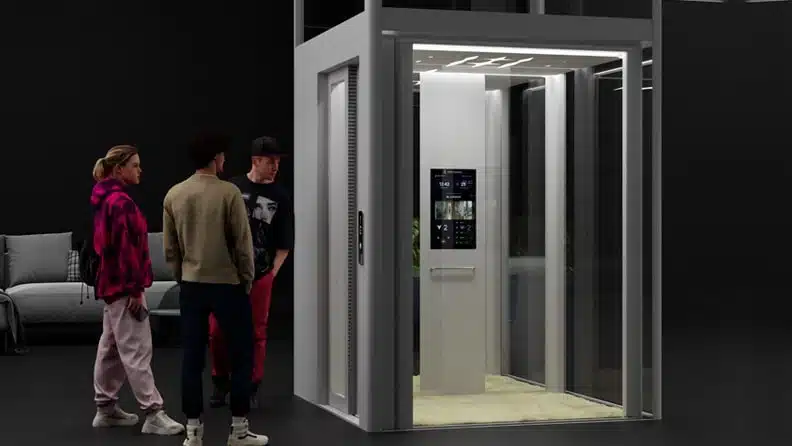
A domestic lift — also called a home lift, household lift, residential lift, or house lift — is a vertical transportation system specifically engineered for private residential use. The engineering brief for a domestic lift is fundamentally different from a commercial elevator: it must be quiet enough not to disturb the home environment, compact enough to fit within a residential footprint, customisable enough to complement a home’s interior design, and safe enough to be operated unsupervised by every member of a household — from young children to elderly grandparents.
In Malaysia, domestic lifts are certified to EN 81-41 — the European safety standard developed specifically for residential vertical lifts in private homes. This standard governs everything from the maximum cabin speed and load to the emergency systems, door safety, and structural requirements appropriate for a home environment. EN 81-41 is not EN 81-20 (the commercial elevator standard) — and the differences between them are not cosmetic. They reflect fundamentally different usage patterns, passenger profiles, and environmental conditions.
What Is a Traditional Elevator?
A traditional elevator — what most Malaysians picture when they hear the word ‘elevator’ — is the type found in office towers, shopping malls, hospitals, and commercial buildings. These are certified to EN 81-20 and EN 81-50, designed for continuous high-volume use by large numbers of passengers under the supervision of building management. They are built for durability under heavy commercial load cycles, not for quiet integration into a living environment.
Traditional commercial elevators require a dedicated machine room (typically above or below the shaft), a deep pit excavation, specific headroom overhead, and significant structural reinforcement of the building fabric around the shaft. The installation timeline is measured in months, the civil works are extensive, and the ongoing maintenance requirements — including annual load testing and regulatory inspection — are managed by professional building operators, not individual homeowners.
Key Differences That Matter for Your Malaysian Home
Size and Footprint
A traditional commercial elevator occupies a much larger footprint than a domestic lift. Machine rooms, counterweight shafts, and structural reinforcement all consume space that a typical Malaysian residential property simply does not have to spare. Modern domestic lifts like Elite’s X200, E200, and X400 range use self-supporting aluminium frames, require no machine room, and need a pit of just 100 to 120 mm — or no pit at all on the X400 series. The structural impact on a Malaysian home is negligible.
Noise and Vibration
Commercial elevators operate in buildings where their mechanical noise is absorbed by the structure and masked by ambient commercial activity. In a home, those same noise levels are unacceptable — audible through walls, disruptive to sleep, and intrusive in living spaces. Domestic lifts are specifically engineered for quiet operation. Elite’s E300 Cogbelt uses a patented gearless cogbelt drive that eliminates virtually all vibration and sound. The X400’s gearless belt drive operates at 1.0 m/s with a noise profile designed for the domestic environment where the shaft may be adjacent to a bedroom.
Safety Standards and Certification
The safety standards for domestic lifts and commercial elevators are different — deliberately. EN 81-41 for residential lifts acknowledges that home elevators are used by a diverse, unsupervised passenger group including children, elderly individuals, and mobility-impaired users who may not respond to emergencies the way a trained commercial elevator user would. The standard mandates specific emergency systems — ARD, emergency communication, five-layer safety architecture — calibrated for this user profile. All Elite home elevators are EN 81-41 certified. Premium models like the X400 Mark II exceed this, meeting EN 81-20 and EN 81-50 — but they are still purpose-engineered for residential use, not commercial repurposing.
Customisation and Aesthetics
Commercial elevators are not designed to be beautiful. They are designed to be durable, functional, and easily serviced. Domestic lifts must be both — and Elite’s range offers 16 RAL colour options, panoramic glass swing doors, LED ceiling configurations, custom flooring, and hidden fastenings that make the cabin feel like a designed element of the home rather than a utility box inside it.
Installation and Civil Works
Commercial elevator installation in Malaysia involves months of civil construction, regulatory approvals, and significant structural intervention. Domestic lift installation with Elite takes 2 to 3 weeks, requires no wet concrete work beyond a simple floor threshold (or no pit at all), and can be carried out while the family continues living in the home. The difference is not marginal — it is categorical.
Why Some Malaysian Homeowners Still Confuse the Two
The confusion persists because some suppliers in Malaysia genuinely do adapt commercial or semi-commercial elevator systems for domestic use — sometimes without disclosing the engineering compromises involved. A commercial-grade elevator installed in a home is noisier, bigger, more expensive to maintain, and certified to a standard that was not written with your home’s usage pattern in mind. The result is a product that technically moves between floors but fails to deliver the domestic lift experience that was the point of the investment.
The distinction between domestic lifts and traditional elevators is not semantic. It is the difference between a product designed for your home and a product adapted for it. Elite Elevators Malaysia’s full range — from the E50 Stairlift to the AI-powered X400 Mark II Elevators — is purpose-built for residential use from first principles. Every design decision, every safety system, every customisation option reflects the specific demands of a Malaysian home environment.
Frequently Asked Questions
1. Can a commercial elevator be installed in a Malaysian home?
Technically yes, but it is strongly inadvisable. Commercial elevators require a dedicated machine room, deep pit, and structural reinforcement that most Malaysian homes cannot accommodate without major renovation. They are noisier, larger, and certified to standards designed for commercial usage patterns, not residential ones. A purpose-built domestic lift from Elite Elevators Malaysia delivers better performance, quieter operation, and a safer passenger experience for significantly less civil work disruption.
2. What certification should a domestic lift have in Malaysia?
Domestic home elevators in Malaysia should be certified to EN 81-41 — the European safety standard specifically developed for residential vertical lifts. This covers structural integrity, braking, door safety, electrical protection, overload prevention, and emergency systems appropriate for home use. Elite’s premium models (X400 Mark II) also meet EN 81-20 and EN 81-50. Always ask for certification documentation before purchasing any home lift in Malaysia.
3. Is a domestic lift the same as a home elevator?
Yes — domestic lift, home lift, home elevator, household lift, and residential lift all refer to the same category of product: a vertical transportation system specifically designed and certified for private residential use. The terminology varies by region and context but describes the same engineering brief: quiet, compact, safe, and customisable for a home environment.
4. How fast does a domestic lift travel compared to a commercial elevator?
Commercial elevators in Malaysian office and retail buildings typically travel at 1.5 to 2.5 m/s or faster. Domestic lifts travel at 0.15 to 1.0 m/s — with Elite’s X400 reaching 1.0 m/s, which is the fastest residential lift speed available in Malaysia. For a home with G+3 or G+4 floors, 1.0 m/s delivers a genuinely fast and comfortable journey. The slower speed of domestic lifts compared to commercial ones is a design choice — not a limitation — appropriate for the shorter travel distances of residential installations.
5. Do domestic lifts require the same maintenance as commercial elevators?
No — domestic lifts have significantly lower maintenance requirements than commercial elevators, which undergo high-volume daily use cycles that wear mechanical components much faster. Elite’s home elevators are designed for low-maintenance ownership: the E200’s Greaseless Rail eliminates lubrication, fluid change intervals extend to ten years, and remote diagnostics on smart models surface issues proactively. An annual professional service visit is the standard requirement — far less than the maintenance schedule of a commercial elevator.
Nur Haneesya
I appreciate the clear explanations and useful practical points throughout the article.
Danish Hakim
Good read with useful information for homeowners planning a lift installation.
Nur Balqis
The article is informative and explains the key points in a reader-friendly manner.
Fawwaz Zulkarnain
Good article with practical information. It is useful for homeowners who are beginning to explore home lift options.
Iman Zafira
Interesting read. The information provides a useful starting point for anyone considering a residential lift.