 Skip to main content
  Add Elite Elevators as preferred


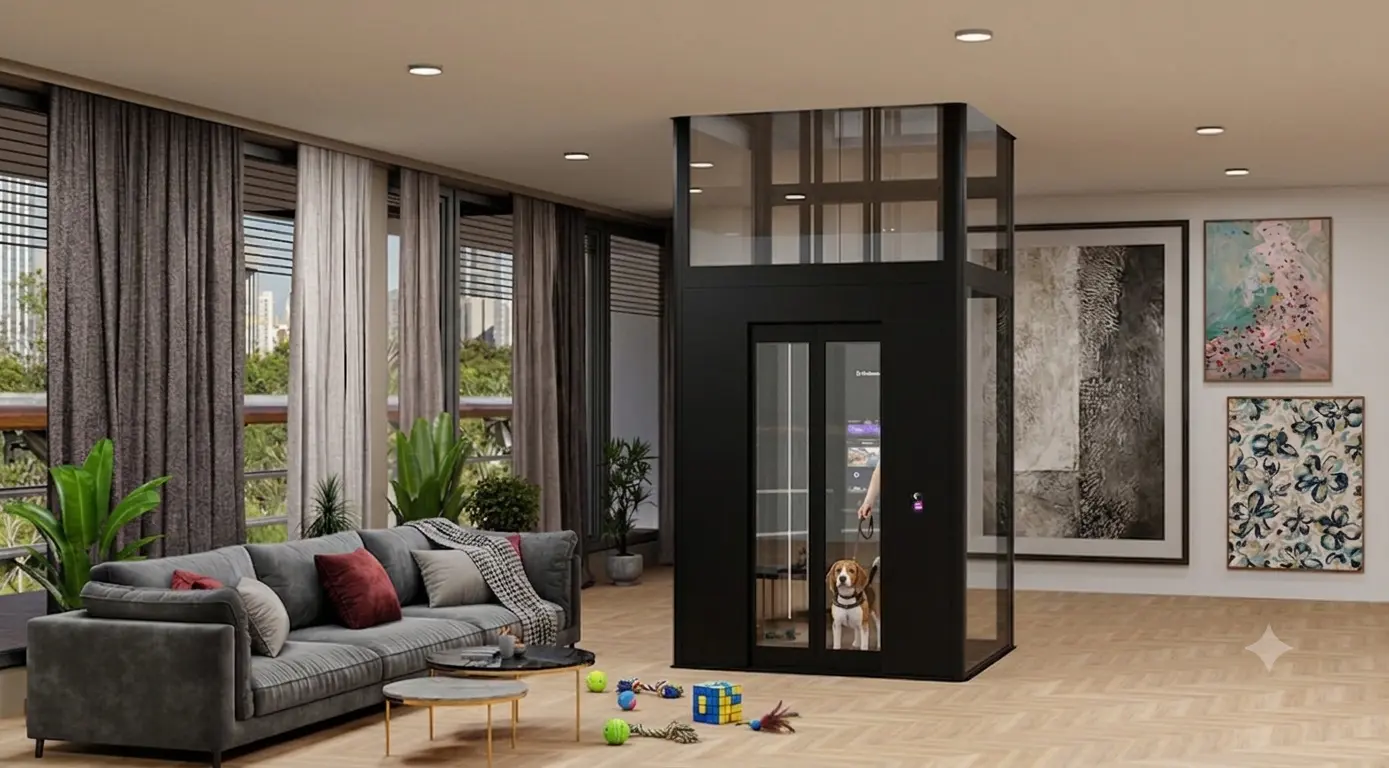
Table of Contents
If you share your home with pets — a Golden Retriever who follows you from room to room, a cat who has claimed the third floor as personal territory, a miniature Schnauzer who treats the stairs like a personal obstacle course — the question of whether a residential elevator is safe for animals is entirely reasonable. In fact, for households where pets have full floor access, it deserves a thoughtful answer rather than a dismissive one.
The concern is not abstract. Pets behave unpredictably around mechanical systems. A dog may lunge forward as doors begin to close. A cat may position itself precisely where a cabin door sensor does not expect anything to be. Leashes can become entangled in door frames. Small animals may not understand that the space between the cabin and the landing edge is not safe to cross. For any pet owner considering a residential lift installation in Malaysia, these are practical safety considerations that deserve direct, honest attention.
The reassuring answer is that well-engineered residential elevators are genuinely safe environments for pets — provided the right features are in place and pet owners understand a small number of practical usage guidelines. This guide covers exactly what makes a residential lift safe for household animals, which Elite Elevators Malaysia features are most relevant for pet-owning households, and the practical considerations that every pet owner should factor into their home elevator decision.
Why Residential Elevators Are Generally Safe for Household Pets
The fundamental safety architecture of a well-engineered residential elevator is highly compatible with pet use. Unlike stairs — which present genuine fall and injury risks for pets, particularly older animals with joint conditions, small breeds on steep staircases, or large breeds whose size makes narrow stair turns awkward — a residential lift provides a flat, fully enclosed, stationary entry point, smooth travel, and a secure cabin environment.
The key safety features that make Elite Elevators Malaysia’s residential lifts safe for pets are the same ones that make them safe for young children and elderly passengers: door safety sensors that detect obstructions during closure, soft-start and soft-stop travel that eliminates sudden movements, smart overload detection, and fully enclosed cabin designs that prevent animals from placing any part of their body outside the cabin boundary during travel.
For most family pets — dogs, cats, and small household animals — a home elevator is not just safe. It is often considerably more practical than stairs. Elderly dogs with hip dysplasia or arthritis who struggle with steep stairs can use a lift with minimal physical effort. Large breeds who cannot easily turn on tight staircase landings travel comfortably in a spacious cabin. Cats, while likely to treat the experience with characteristic inscrutability, typically adapt quickly to elevator use.
The Key Safety Features That Protect Pets in a Residential Lift
Door Safety Sensors — The Most Critical Feature for Pet Owners
For pet-owning households, door safety sensors are the single most important feature to verify in any residential elevator. A leash can become caught in a closing door. A cat may dart toward the gap as doors close. A dog may position itself partially in the doorway. Elite Elevators Malaysia’s home lifts incorporate door safety sensors that continuously monitor the door opening during closure and immediately reverse door movement upon detecting any obstruction — regardless of size, weight, or position. This protection is active throughout the entire door closing cycle, not just at the final moment of contact.
Soft-Start and Soft-Stop Technology
Animals — particularly dogs — can be startled or destabilised by sudden movement. A residential lift that jolts at the start or end of travel creates an unpleasant and potentially unsafe experience for pets. Elite Elevators Malaysia’s hydraulic chain drive and gearless belt drive systems use soft-start and soft-stop technology that produces smooth, gradual acceleration and deceleration. Pets travel stably and comfortably without needing to compensate for sudden movement changes.
Noise Level and Pet Anxiety
Many animals — dogs particularly — are sensitive to mechanical noise. A loud, vibrating elevator can trigger anxiety responses that make future use stressful. Elite Elevators Malaysia’s residential lifts are engineered for near-silent operation — the hydraulic chain drive systems produce minimal operational noise, and the gearless belt drive systems operate at whisper-quiet levels. This low acoustic profile significantly reduces the likelihood of noise-related stress responses in household pets, making the initial adaptation period smoother and ongoing use more comfortable for animals throughout the home.
Enclosed Cabin Design and Floor Gap Management
The gap between the cabin floor and the landing level is a practical safety consideration for small animals and those with small paws or feet. Elite Elevators Malaysia’s precision auto re-levelling technology ensures the cabin aligns precisely with floor height at every stop — minimising the floor gap and creating a smooth, level boarding surface that is safe for animals of all sizes. The enclosed cabin design prevents any part of a pet from extending outside the cabin boundary during travel.
Practical Guidelines for Pet Owners Using Residential Lifts
While well-engineered residential elevators are safe for pets, a small number of practical usage guidelines ensure the experience remains safe and positive for both animals and their owners over the long term.
Always hold or shorten leashes before entering the cabin. A lead-walking dog should have their leash shortened to arm’s length before stepping into the elevator — preventing any possibility of the leash becoming trapped in the door as it closes. This is the single most important practical guideline for dog-owning households and should become habitual from the very first use.
Introduce pets to the elevator gradually. Most pets adapt well to residential lifts, but the initial introduction benefits from a gradual approach. Allow the animal to investigate the stationary cabin first. Take short, gentle trips with the pet before allowing independent access. Positive reinforcement during the introduction period consistently produces faster, more confident adaptation across all animal types.
Consider floor restriction for pets that should not access certain levels independently. The biometric and PIN-based floor restriction available in the Elite X400, X400 Mark II, and X200 Plus can be used to prevent pets from independently accessing floors where they should not go unsupervised. While pets cannot operate the lift controls directly, if the cabin is called by another household member, floor restriction ensures pets cannot be accidentally transported to restricted levels.
For elderly or mobility-impaired pets, the residential lift is often genuinely better than stairs. A dog with hip dysplasia who has been struggling with three flights of stairs for years will typically take to elevator use quickly once the association between the cabin and effortless floor access is established. The residential lift can meaningfully extend the quality of life of mobility-challenged pets — just as it does for elderly human family members.
Which Elite Elevators Malaysia Residential Lift Is Best for Pet-Owning Households?
For most Malaysian pet-owning households, the key features to prioritise are door safety sensor quality, smooth soft-start travel, near-silent operation, and cabin dimensions that comfortably accommodate the household’s animals alongside human passengers.
The Elite X200 hydraulic home lift is an excellent starting point for households with pets — its door safety sensors, soft hydraulic travel, and quiet operation profile create a comfortable and safe environment for animals. Its 400 kg load capacity is more than sufficient for any combination of human and pet passengers, and its compact footprint fits naturally into Malaysian terrace houses and duplexes where space is at a premium.
For larger households or those wanting smart floor restriction for pet management, the X200 Plus adds biometric access control and mobile app monitoring alongside the core X200 safety profile. The X400 gearless belt drive range — with its 1500 mm x 1500 mm cabin option and 440 kg capacity — is the natural choice for households with larger breeds where cabin space is an important consideration. All models include the door safety sensors, ARD, and soft-start technology that make Elite Elevators Malaysia’s residential lifts safe for every member of the household — including the four-legged ones.
Frequently Asked Questions
1. Can I take my dog in a residential elevator in Malaysia?
Yes. Elite Elevators Malaysia’s residential lifts are designed to serve all members of the household, including pets. With door safety sensors, soft-start travel, near-silent operation, and enclosed cabin designs, they provide a safe and comfortable travel environment for dogs of all sizes — provided leashes are shortened before entry, as a standard safety practice.
2. Are cats safe in a home elevator?
Yes. The enclosed cabin, door safety sensors, and precision auto re-levelling create a safe environment for cats. As with any new mechanical system in the home, a gradual introduction with positive reinforcement helps cats adapt comfortably. Most cats become accustomed to the residential lift within a short period of regular use.
3. What happens if a pet gets caught in the elevator door?
Elite Elevators Malaysia’s residential lifts incorporate door safety sensors that detect any obstruction during door closure and immediately reverse door movement. This protection is active throughout the entire closing cycle — not just at the point of contact — ensuring that a pet partially in the doorway triggers the reversal response before any contact or pressure is applied.
4. Is a residential lift better than stairs for elderly or arthritic pets?
In many cases, yes. Elderly pets with joint conditions, hip dysplasia, or mobility impairments often find stairs increasingly difficult and painful. A residential lift with its flat boarding surface, smooth travel, and effortless floor-to-floor access provides a significantly less physically demanding alternative — potentially extending the animal’s comfort and independence within the home.
5. How do I introduce my pet to using a home elevator?
Start by allowing the pet to explore the stationary cabin at their own pace. Take short trips with the pet on lead before any independent access. Use positive reinforcement throughout the introduction period. Most household pets — particularly dogs — adapt confidently within a few sessions when the introduction is gradual and positive.
Fawwaz Hakimi
A useful article with practical details that homeowners can take into account.
Nur Balqis Hana
Thanks for sharing this article. The information is clear and gives homeowners useful points to consider.
Nur Damia Farhana
Thanks for this informative article. It gives homeowners useful points to think about before starting a home lift project.
Mohd Zafran
A helpful guide for homeowners considering whether a residential elevator is suitable for their property.
Afiq Firdaus
Good read. The practical information makes it easier to understand what to consider before installation.
Siti Haneefa Sofea
The article provides useful information in a clear and accessible format.