 Skip to main content
  Add Elite Elevators as preferred


Table of Contents
- What Each Solution Actually Occupies
- The Space the Stairlift Takes That Nobody Mentions
- The Space a Home Lift Trades for What It Gives Back
- Stair Lift Cost vs Home Lift Cost: The Space-Value Equation
- Stair Lifts for Seniors: Which Saves More Space in Practice?
- What Each One Does to Your Floor Plan Long-Term
- Which One Is Right for Your Home?
- Frequently Asked Questions
- 1. Does a stairlift take up much space in a Malaysian terrace house?
- 2. Is a stairlift cheaper than a home lift in Malaysia?
- 3. Can a stairlift and a home lift both be installed in the same Malaysian home?
- 4. Which saves more space — a chair lift for stairs or a home lift?
- 5. Are stair lifts for seniors safe to use independently?
- 6. Can a home lift be installed in a completed Malaysian home without major renovation?
Space is the one thing most Malaysian homeowners cannot make more of.
A double-storey terrace in Cheras. A semi-D in Shah Alam. A completed bungalow in Johor Bahru. Every one of these homes has a fixed floor plan — and any vertical mobility solution you add has to fit within it, not fight against it.
So when the question is home lift or stair lift, the space conversation is often the deciding one. This guide answers it honestly — what each solution actually takes, what each one gives back, and how to decide which is right for your specific home.
What Each Solution Actually Occupies
Let’s start with physical reality.
A stair lift mounts on the staircase itself. The rail fixes to the stair treads. The seat, footrest, and armrests fold flat when not in use. The floor area it occupies permanently is essentially zero — it lives on the stairs, not beside them.
When folded, the Elite E50 Stairlift leaves adequate clearance for other family members to use the stairs normally alongside it. There is no shaft. No pit. No floor opening. No dedicated space anywhere in the home that becomes permanently unavailable.
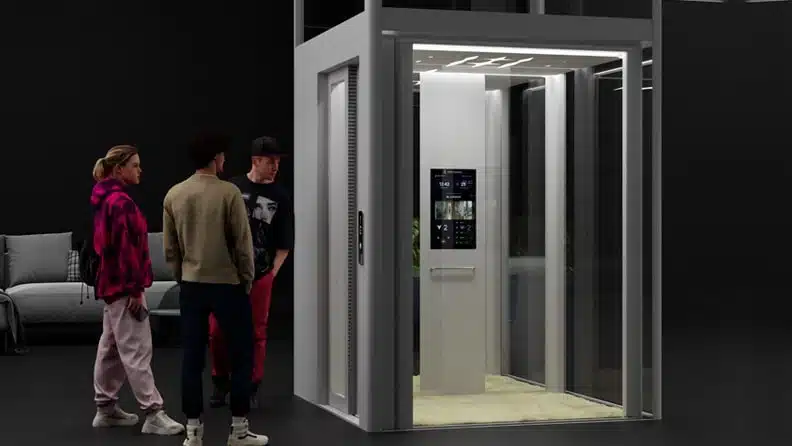
A home lift requires a shaft — a vertical column of space that runs through every floor it serves. Typically starting from around 900 x 900 mm at the minimum, with standard installations around 1.5 square metres per floor level. That footprint is permanently allocated to the lift on every floor, plus the landing space in front of the doors.
On paper, the stairlift uses less space. In practice, the picture is more nuanced.
The Space the Stairlift Takes That Nobody Mentions
A stairlift does not take floor space. But it does take staircase space — and that has a consequence.
When the E50 is in use, the seat occupies most of the staircase width. For a family member using the stairs at the same time, they must wait. On a narrow terrace house staircase of 800 to 900 mm, the folded clearance is adequate but not generous.
More importantly: a stairlift changes how you use the staircase. The rail is permanently present on the wall-side of every step. It cannot be removed for a dinner party or a furniture delivery. It is there, always — which most families quickly stop noticing, but it is a real aesthetic and physical presence.
For homes where the staircase is a design feature — open-plan, visible from the living area, part of the home’s character — this is worth weighing carefully.
The Space a Home Lift Trades for What It Gives Back
A home lift does take a defined shaft footprint on every floor.
In a terrace house, this is typically adjacent to the existing staircase — the zone where structural penetration between floors is already accommodated. In a bungalow, placement is more flexible.
What the home lift gives back in exchange for that footprint:
- The staircase is completely unaffected — full width, full clearance, fully usable by everyone at all times
- The landing space in front of the lift doors remains usable until the lift is called
- The cabin itself is usable space — you can carry groceries, laundry, furniture, and mobility equipment between floors
- The visual impact is contained to the shaft and landing doors, not distributed across the staircase
For larger homes and families with heavier daily usage, the functional return on the shaft footprint is significant. The lift earns its square metres.
Stair Lift Cost vs Home Lift Cost: The Space-Value Equation
Stair lift cost is significantly lower than a full home elevator. The Elite E50 is the most accessible entry point into certified home vertical mobility in Malaysia — no civil works, no shaft construction, no multi-week installation programme.
A home elevator involves higher upfront cost — the product, the civil works for shaft and pit, and the 2 to 3 week installation timeline.
But cost and space are connected. The lower stair lift cost reflects the absence of civil works — which also means the absence of structural disruption, the absence of planning considerations, and the ability to install in a completed home in a single day.
For families where budget is the primary consideration, the E50 resolves the staircase problem at a fraction of the home elevator investment. For families who need full cabin access — wheelchair users, heavy daily loads, multi-floor movement for multiple people — the higher investment in a home lift delivers capability the stairlift cannot match.
Stair Lifts for Seniors: Which Saves More Space in Practice?
For elderly family members specifically, the space question often resolves differently than it does for younger households.
Stair lifts for seniors in a completed Malaysian home are frequently the right answer — particularly when:
- The home is a straightforward double or triple storey
- The elderly person needs staircase access, not full multi-floor cabin travel
- Budget favours a lower-cost solution
- Installation disruption needs to be minimal
- The staircase geometry is compatible with the E50’s rail configuration
The chair lift for stairs — what most people picture when they think of a stairlift — serves this brief well. The seat is comfortable. The ASL technology ensures smooth swivel at each floor. The seven safety layers protect elderly passengers independently.
A home lift becomes the stronger choice for seniors when:
- A wheelchair or mobility equipment needs to travel between floors
- The elderly person cannot comfortably transfer to a seated stairlift position
- Multiple floors need to be served and the travel height makes a stairlift impractical
- The household wants smart features like biometric access, Live SOS, and caregiver monitoring
What Each One Does to Your Floor Plan Long-Term
Think about your home in 10 years.
The stairlift rail is on your staircase. It has been there for a decade. It is now part of the home’s identity — useful, unobtrusive, but permanent unless removed. Removing it leaves minimal trace. That reversibility has real value for homeowners who are not certain of their long-term plans.
The home lift shaft is a permanent structural feature. It adds a lift to your home’s floor plan that will be there for 15 to 20 years. At resale, it is a value-adding feature — Malaysian properties with certified home elevators are increasingly commanding measurable premiums, particularly among buyers with multi-generational households or accessibility needs.
The stairlift is more flexible and reversible. The home lift is a deeper, longer-term commitment — with correspondingly greater long-term value.
Which One Is Right for Your Home?
Choose a stairlift (Elite E50) if:
- Your staircase is the primary accessibility barrier
- You want zero civil works and same-day installation
- Budget strongly favours a lower-cost solution
- The home is completed and shaft installation is not practical
- The user can comfortably use a seated stairlift independently
Choose a home lift if:
- Multiple family members need vertical mobility daily
- A wheelchair user needs full cabin access
- You have three or more floors and travel speed matters
- Carrying loads between floors is a regular requirement
- You want smart features, cabin customisation, or the lift as a design feature
Both are available from Elite Elevators Malaysia. A free site survey will confirm which solution fits your specific home — without obligation.
Frequently Asked Questions
1. Does a stairlift take up much space in a Malaysian terrace house?
The E50 Stairlift mounts on the stair treads with no floor space consumption. When folded, it leaves adequate passage for other staircase users. In a standard Malaysian terrace staircase of 800 to 900 mm width, the folded E50 provides clearance for family members to pass. The only permanent presence is the rail along the wall side of the staircase.
2. Is a stairlift cheaper than a home lift in Malaysia?
Yes — significantly so. The E50 Stairlift requires no civil works, no shaft, and no multi-week installation. The stair lift cost is a fraction of a full cabin home elevator investment. For households where the primary need is staircase accessibility rather than full multi-floor cabin travel, the E50 is the most cost-effective certified solution.
3. Can a stairlift and a home lift both be installed in the same Malaysian home?
Yes. Some families install the E50 Stairlift as an immediate solution while planning a full home elevator installation during a future renovation. The stairlift is fully removable and leaves no permanent structural impact. This phased approach lets families address the immediate accessibility needs at lower cost while preserving the option for a full elevator later.
4. Which saves more space — a chair lift for stairs or a home lift?
A chair elevator for stairs saves more floor space — it occupies the staircase rather than a separate shaft footprint. A home lift takes a defined shaft area on every floor. However, a home lift leaves the staircase completely unaffected and provides full cabin access for wheelchair users, heavy loads, and multiple passengers simultaneously. The right choice depends on your usage requirements, not just the footprint comparison.
5. Are stair lifts for seniors safe to use independently?
Yes. The Elite E50 includes seven integrated safety layers — obstruction detection, seatbelt monitoring, anti-rollback, overspeed protection, and controlled stop on any detected fault. The ASL technology automatically positions the seat for safe boarding and alighting at every floor. The lift runs on continuous battery charge, including during power outages. It is specifically designed for elderly and limited-mobility users operating independently.
6. Can a home lift be installed in a completed Malaysian home without major renovation?
Yes. Elite’s hydraulic range (X200, X200 Plus, E200) requires only a 100 to 120 mm pit and no machine room. The X400 requires no pit at all. Most completed Malaysian terrace houses, semi-detached homes, and bungalows can accommodate an Elite home lift installation within 2 to 3 weeks with minimal civil disruption.
Nur Mardhiah
A helpful resource for anyone researching residential lifts for their home.
Nur Qaseh Sofea
I found the information informative and well structured.
Nur Rania
I found this guide helpful. It provides useful information for homeowners who are still exploring their lift options.
Syahir Hakim
Very informative guide. The practical information is useful for anyone planning a lift for their home.
Nur Balqis Hana
Thanks for sharing this article. The information is clear and gives homeowners useful points to consider.