Skip to main content
  Add Elite Elevators as preferred
Table of Contents
- How Elevators Work: The Technology Behind Vertical Mobility in Malaysia
- How Escalators Work: When Moving Walkways Between Floors Make Sense
- Elevators vs Escalators: A Direct Comparison for Malaysian Applications
- Why Home Elevators in Malaysia Are Always the Right Choice for Residential Applications
- Choosing the Right Elevator Supplier in Malaysia: What to Look For
- Frequently Asked Questions
- 1. Can an escalator be installed in a Malaysian home?
- 2. What type of elevator is best for a Malaysian home?
- 3. Are hydraulic elevators safe for elderly and mobility-impaired users in Malaysia?
- 4. How do I choose a reliable elevator supplier in Malaysia?
- 5. What is the difference between a residential elevator and a commercial elevator in Malaysia?
It seems like a straightforward question: elevator or escalator? In practice, however, the decision is made incorrectly with surprising frequency — particularly in the Malaysian context, where property developers, architects, and business owners are often working under budget, timeline, and space constraints that push them toward a quick decision rather than the right one. The consequences of choosing the wrong vertical transport solution can be significant: ongoing operational costs that exceed projections, passenger accessibility limitations that create liability, or maintenance requirements that were not anticipated during the planning phase.
For residential applications, the question rarely arises — escalators are not a practical option for Malaysian homes, and the elevator conversation is about choosing the right type rather than the right category. But for commercial properties, shopping complexes, office buildings, mixed-use developments, and hospitality projects in Malaysia, the elevator versus escalator decision is genuinely consequential. Getting it right requires understanding what each solution actually delivers — not just in terms of moving people between floors, but in terms of accessibility, capacity, safety, installation impact, and long-term cost of ownership.
This guide provides an honest, comprehensive comparison of elevators and escalators — covering every dimension that matters for Malaysian property owners and developers. For those specifically evaluating home elevators in Malaysia, it also explains why escalators have no role in the residential context and what the relevant elevator options are for different residential configurations.
How Elevators Work: The Technology Behind Vertical Mobility in Malaysia
An elevator — also called a lift — is an enclosed cabin that travels vertically between designated floors, serving one group of passengers at a time. Multiple drive system types are available for different applications: hydraulic elevators use fluid pressure to raise and lower the cabin; gearless belt drive systems use a direct-drive belt mechanism; and AI-powered systems add intelligent destination prediction and biometric access to the core vertical transport function.
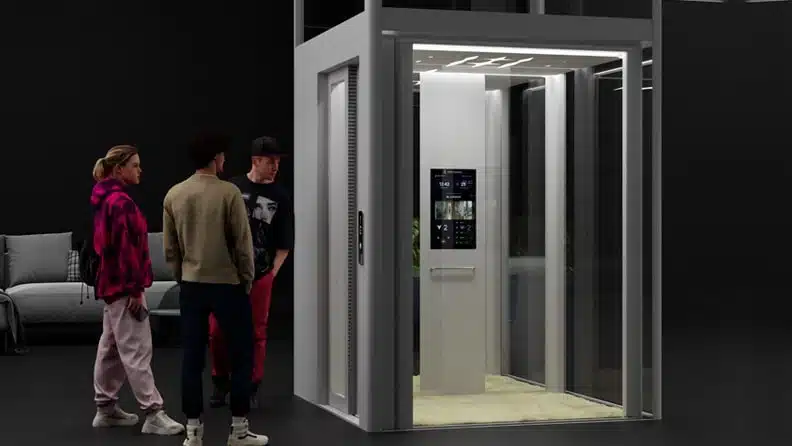
For residential applications, hydraulic elevators in Malaysia — such as the Elite X200 and E200 range — are widely chosen for their quiet operation, minimal installation requirements, and strong safety certification profile. For commercial applications requiring higher capacity and more frequent usage cycles, traction-based or gearless drive systems are more appropriate. Hydraulic elevators are particularly well-suited to the Malaysian residential context because they require no deep pit, no machine room, and operate on single-phase power supply compatible with typical residential electrical infrastructure.
The defining characteristics of elevators that make them applicable across both residential and commercial settings are: fully enclosed passenger cabin providing complete safety and comfort; wheelchair and mobility aid accessibility; ability to transport goods, luggage, and heavy items; operation for all passenger types including elderly, young children, and mobility-impaired users; and a wide range of capacity options from small residential cabins to high-capacity commercial cars.
How Escalators Work: When Moving Walkways Between Floors Make Sense
An escalator is a continuously moving staircase — a loop of linked steps driven by a motor, carrying passengers between two floor levels without stopping. Unlike elevators, escalators operate continuously in one direction and handle a continuous flow of passengers simultaneously, making them highly efficient for high-volume, unidirectional passenger movement.
The environments where escalators deliver genuine advantages are specific and well-defined: high-traffic retail environments such as Malaysian shopping malls where thousands of shoppers move between levels continuously; transit hubs including airports, train stations, and bus terminals; and large commercial complexes where floor-to-floor passenger volumes justify the infrastructure investment and operational cost.
However, escalators have fundamental limitations that make them unsuitable for many applications. They cannot transport wheelchair users, mobility aid users, or passengers with significant mobility impairments — a serious accessibility limitation that has legal implications under Malaysian disability accessibility regulations. They cannot transport goods, luggage, or heavy items safely. They require a large, dedicated structural footprint that is incompatible with most residential or small commercial settings. And their continuous operation creates higher energy consumption and maintenance costs than elevator systems serving comparable passenger volumes.
Elevators vs Escalators: A Direct Comparison for Malaysian Applications
| Factor | Elevator | Escalator |
| Wheelchair accessibility | Full accessibility | Not accessible |
| Goods transport | Yes — luggage, groceries, mobility aids | No — passengers only |
| Residential suitability | Ideal — wide range of residential models | Not suitable for residential use |
| Power failure safety | ARD safely lowers cabin to nearest floor | Stops abruptly — fall risk on steps |
| Installation footprint | Compact — no deep pit, no machine room required | Large — dedicated structural footprint required |
| Energy consumption | On-demand — draws power only during use | Continuous — runs whether in use or not |
| Elderly and child safety | High — enclosed, stationary boarding, soft travel | Risk — moving steps, fall risk for elderly and young children |
Why Home Elevators in Malaysia Are Always the Right Choice for Residential Applications
For Malaysian homeowners, the elevator versus escalator question has a clear and unambiguous answer: elevators are the only appropriate solution for residential vertical mobility. Escalators are physically unsuitable for residential installation — they require a structural footprint that exceeds the available space in any residential property, consume energy continuously regardless of usage, and cannot serve the diverse range of passengers and items that a home lift must accommodate daily.
Within the residential elevator category, the range of options available from Elite Elevators Malaysia covers every type of Malaysian home and household requirement. The X200 and E200 hydraulic ranges serve compact homes and those prioritising energy efficiency and accessible pricing. The E300 gearless cogbelt range delivers Italian-precision quiet performance for homeowners who want the refinement of gearless technology at a mid-premium price point. The X400 gearless belt drive range provides the highest performance at 1.0 m/s for luxury Malaysian residences. And the X400 Mark II adds AI intelligence, biometric security, and full smart home integration for the most forward-thinking Malaysian households.
Choosing the Right Elevator Supplier in Malaysia: What to Look For
For Malaysian homeowners and property developers evaluating elevator suppliers, the key differentiators between a genuinely strong provider and an average one come down to certification credentials, product range depth, installation quality, and after-sales support infrastructure.
A reputable elevator supplier in Malaysia should be able to provide specific EN 81 certification documentation for every model in their range, demonstrate a verifiable track record of successful installations in Malaysian residential and commercial properties, operate their own certified installation and service teams rather than using subcontractors, and offer transparent, comprehensive quotes with no hidden costs. Elite Elevators Malaysia meets all of these criteria across a full range of residential elevator solutions — with more than 3,000 successful installations and a dedicated after-sales service team supporting every product in the range.
Frequently Asked Questions
1. Can an escalator be installed in a Malaysian home?
No. Escalators require a large structural footprint, operate continuously, and cannot serve the diverse passenger and goods transport needs of a residential setting. Home elevators are the appropriate and only practical vertical mobility solution for Malaysian residential properties.
2. What type of elevator is best for a Malaysian home?
The best home elevator for a Malaysian residence depends on the number of floors, household usage requirements, space constraints, and technology preferences. Hydraulic models (X200, E200) offer reliable, accessible performance. Gearless models (X400 range) deliver premium speed and low maintenance. AI-powered models (X400 Mark II) provide the most advanced smart living experience. A site assessment by Elite Elevators Malaysia will identify the optimal configuration for your specific home.
3. Are hydraulic elevators safe for elderly and mobility-impaired users in Malaysia?
Yes. Elite Elevators Malaysia’s hydraulic home elevators are EN 81-41 certified with five embedded safety layers, soft-start travel, Automatic Rescue Device, door safety sensors, and smart overload detection — specifically designed to serve diverse passenger groups including elderly family members, young children, pregnant women, and mobility-impaired users safely and comfortably.
4. How do I choose a reliable elevator supplier in Malaysia?
Look for specific EN 81 safety certification documentation, a verifiable installation track record, own-team (not subcontracted) installation and service capability, transparent pricing with no hidden costs, and genuine after-sales support infrastructure. Elite Elevators Malaysia satisfies all of these criteria across a comprehensive residential elevator range.
5. What is the difference between a residential elevator and a commercial elevator in Malaysia?
Residential home elevators in Malaysia are designed for private domestic use — optimised for quiet operation, compact installation, low energy consumption, and diverse household passenger groups. Commercial elevators are designed for higher usage cycles, larger passenger capacities, and more demanding structural environments. Elite Elevators Malaysia specialises in the residential category, with a full range of home elevator solutions certified to European standards.