Skip to main content


Table of Contents
Finding a home elevator supplier in Malaysia is easy. Finding one whose lift fits an existing home without major construction is not. Most conventional lifts need three things many houses cannot easily provide: a pit dug below the ground floor, a separate machine room, and extra headroom at the top of the shaft.
Each requirement adds cost and disruption. A pit means hacking finished flooring, pouring concrete and waterproofing, which is a real risk in low-lying areas prone to seepage. A machine room permanently takes floor space from a storeroom or corridor. Low top-floor ceilings can rule out a lift entirely, and the whole process can stretch for months while the home is a construction site.
Pitless and shallow-pit lifts with no machine room solve these problems. This guide explains what to check before choosing a lift supplier, compares elite elevators models by pit depth, headroom and capacity, and answers common questions about installing a lift in an existing home.
What to Look for in a Home Elevator Supplier for No-Pit Installations?
“No pit” is used loosely in lift marketing, so it is worth knowing what to ask before signing anything.
- Exact pit depth: Some lifts need no pit at all. Others need a shallow recess of 59 mm to 120 mm, which can usually be achieved within the existing floor screed or with a small ramp. A supplier should state the figure clearly, with and without a shaft enclosure.
- Machine room status: Gearless belt-drive lifts and some modern hydraulic units keep the motor and controller inside the shaft structure. Confirm that nothing needs to be built outside the lift footprint.
- Headroom at the top floor: A lift that saves space at the bottom can still demand height at the top. Check the minimum headroom against your top-floor ceiling height before choosing a model.
- Safety certification: EN 81-41 is the European standard for home lifts, and EN 81-20 covers passenger lift construction. Certification shows that the design has been tested, not described.
- Retrofit experience: Installing a lift in an occupied home is different from installing one in a new build. Ask how many retrofit projects the supplier has completed and how long a typical installation takes.
Why Pit and Machine Room Requirements Matter When Comparing Elevator Companies Malaysia?
When comparing elevator companies Malaysia, the pit and machine room are often the deciding factors, because they drive the hidden costs.
A deep pit involves excavation, reinforced concrete, waterproofing and sometimes approval from a structural engineer. In older homes, or in low-lying areas where the water table is high, a pit can also become a long-term leakage risk. A machine room adds construction cost and permanently takes floor area, which matters in Malaysian homes where land is expensive and layouts are tight.
A pitless or shallow-pit lift with no machine room avoids most of this. The lift sits on the existing floor, the shaft can be a self-supporting glass and aluminium structure, and installation becomes far less disruptive. For elderly residents or family members recovering from surgery, that can mean having a working lift within weeks instead of months.
There is also a design benefit. Without a machine room, the lift can be placed in a stairwell void, a corner of the living area or even outdoors. Architects get more freedom, and homeowners avoid rearranging their floor plan around the equipment.
What are the Specifications of the No-Pit Home Lift Range from Elite Elevators?
Elite Elevators offers several models designed for minimal civil work. The table below compares the installation requirements and key specifications from each model’s product page.
| Model | Pit depth | Headroom | Installation setting | Best suited for |
| X400 | No pit | No special headroom required | New and existing homes | Villas and duplexes needing a large glass cabin with zero excavation |
| X400 Plus | 60 mm | No special headroom required | New and existing homes | Villas and duplexes needing a large glass cabin with zero excavation |
| X400 Mark II | 59 mm (100 mm with shaft) | Not specified | Indoor and outdoor | Multi-storey homes up to G+5 that want smart features |
| X400 MK II Plus | 60 mm (100 mm with shaft) | 2,600 mm | Indoor and outdoor | Completed homes needing a lift with biometric access and AI controls |
| E200 | Approx. 120 mm, or none with a threshold or ramp | Approx. 2,300 mm | Indoor and outdoor, metallic or masonry shaft | Homes preferring hydraulic drive on single-phase power |
| E50 stair lift | No pit or shaft | Not applicable | Straight, curved and spiral stairs as narrow as 610 mm | Homes where a full lift shaft is not possible |
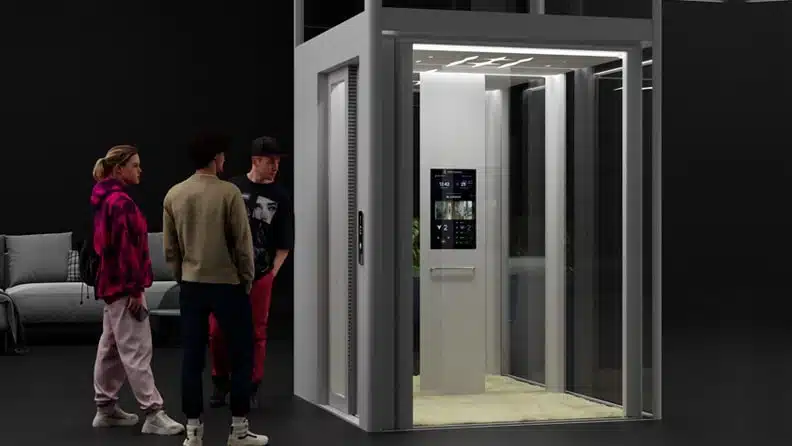
The X400 is the only model in the range marketed with no pit, machine room or special headroom requirement. It also offers a glass cabin of up to 1500 × 1500 mm, which elite elevators describes as the largest in its category.
The X400 Mark II and MK II Plus need only a shallow recess of about 60 mm. They add Elite AI destination prediction, fingerprint floor access, a 21-inch Live Board touch display and a travel height of up to 21,000 mm.
The E200 suits homeowners who prefer hydraulic technology. It runs on single-phase power, uses greaseless rails, reaches a travel height of 13,100 mm and is available in eight standard cabin sizes or custom dimensions.
The E50 stair lift mounts directly on the staircase. It fits straight, curved and spiral stairs as narrow as 610 mm.
Why Homeowners Choose Elite Elevators as Their Lift Supplier in Malaysia?
Beyond pit depth, a good lift supplier in Malaysia should make ownership straightforward for years after installation. Elite elevators cover this in several ways.
- Low-disruption installation: Without excavation or a machine room, most of the work happens inside the shaft. The E200, for example, can be installed in 3-5 weeks once the shaft is in place.
- Low-maintenance mechanics: Greaseless guide rails are used across the range, so there is no oil on the rails, less dust and less squeaking. The X400 series also monitors belt tension in real time.
- Safety for all: Depending on the model, features include dual emergency brakes, overspeed governors, a full-height door light curtain, overload detection and an Automatic Rescue Device. The ARD brings the cabin to the nearest floor during a power cut so passengers can step out safely. GSM emergency calling and Live SOS 2.0 keep help within reach.
- Design flexibility: The X400 range offers 16 RAL colours across standard, metallic and textured finishes, along with glass cabins and a choice of ceilings. Indoor and outdoor installations are both supported.
- Long-term support: Elite Elevators reports more than 3,000 installations and over a decade in the industry. X400 lifts connect to the support network for remote diagnostics and software updates, and homeowners can visit experience centres in Malaysia to see finishes and ride a lift before deciding.
Frequently Asked Questions
1. Can a home elevator be installed without a pit?
Yes. The elite elevators X400 need no pit, machine room or special headroom. The X400 Mark II needs only 59 mm without a shaft, and the X400 MK II Plus needs 60 mm. The E200 needs about 120 mm, or no pit at all when a threshold or ramp is used.
2. Do home lifts in Malaysia need a machine room?
Not always. Gearless belt-drive lifts such as the elite elevators X400 series house the motor within the lift structure, so no machine room is needed. The E200 hydraulic lift is also designed to work without a machine room, which saves floor space in compact homes.
3. How much headroom does a home elevator need?
It depends on the model. The elite elevators X400 MK II Plus need 2,600 mm of headroom, and the E200 needs approximately 2,300 mm as standard. The original X400 is designed without a special headroom requirement, which suits homes with lower top-floor ceilings.
4. Can I install a lift in an existing house in Malaysia?
Yes. Shallow-pit and pitless lifts are well suited to retrofits. Elite elevators such as the X400 Mark II and E200 are designed for both new builds and completed homes with minimal civil work. They can be installed indoors or outdoors, in a glass shaft or a masonry shaft.
5. What happens to a home lift during a power failure?
Elite Elevators home lifts include an Automatic Rescue Device that moves the cabin to the nearest floor during an outage. Models also include battery-backed GSM emergency calling. The E200 keeps the cabin light and fan running, and its hydraulic system allows zero-power descent.