Skip to main content


Table of Contents
Choosing a lift company in Malaysia for a luxury home is a significant decision. Many homeowners only find out what a lift really demands after construction has started: a deep pit that requires breaking a finished slab, a machine room that takes space meant for a wardrobe or store, and a shaft that disrupts an otherwise carefully planned layout.
The problems do not stop at installation. Oily rails attract dust, noisy motors carry into nearby bedrooms, and limited finish options leave the cabin looking out of place against premium interiors. Some suppliers also offer little support after handover, so a costly lift ends up with slow servicing and hard-to-find parts.
That is why architects now shortlist lift suppliers at the design stage. This guide explains the criteria they use, compares hydraulic and gearless drive systems, and shows how Elite Elevators’ home lifts meet the space, design and safety needs of luxury residential projects.
What Do Architects Expect From a Lift Company in Malaysia?
Ask an architect how they pick a lift supplier, and the answer rarely starts with price. It starts with what the lift will do to the building.
Minimal civil work: Deep pits and machine rooms are the biggest source of friction in residential projects, especially in renovations. A lift that sits on a 60 mm to 120 mm pit can go into a completed home without excavation, while a conventional lift may need far more.
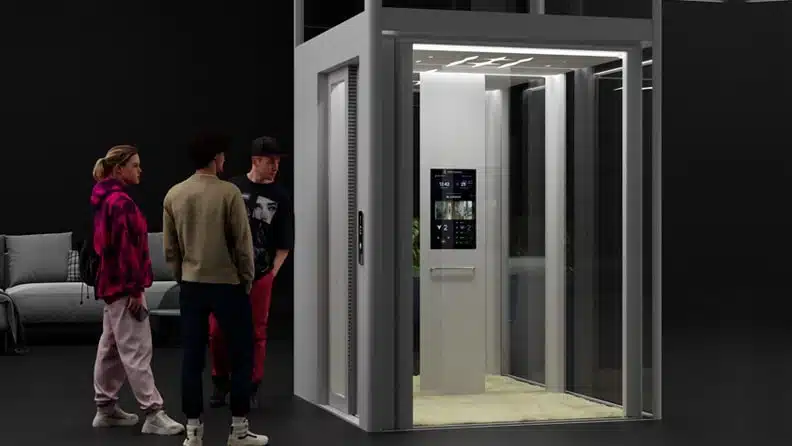
Design in the room: In a luxury home, the lift is often visible from the living area or the staircase void. Architects look for glass cabins, panoramic doors, concealed fixings and a broad colour palette, so the lift reads as part of the interior and not as an appliance.
Certified safety: European standards such as EN 81-41 (for home lifts) and EN 81-20 are a useful benchmark because they cover residential use specifically. Architects also want emergency features they can explain to clients: automatic rescue during power cuts, overload protection, door sensors and an emergency line.
Quiet operation and ride comfort: A lift that hums or jolts beside a master bedroom will generate complaints for years.
Someone to call later: Local service teams, remote diagnostics and experience centres where clients can see finishes in person all reduce risk for the design team.
What is the Right Home Lift: Hydraulic or Gearless?
Before comparing any home lift brand, it helps to decide on the drive technology, because it shapes almost every other decision.
Hydraulic home lifts move the cabin with a hydraulic unit, often through a chain. They are steady, quiet and handle heavy loads well, which suits families who move groceries, luggage or furniture between floors. A key advantage is safe descent during a power failure. Older hydraulic designs had a reputation for oily rails, but newer systems use greaseless rails to keep the shaft clean.
Gearless belt-drive lifts use a compact motor and a belt instead of gears or hydraulics. They are faster, more energy-efficient and need very little pit depth. For taller homes, where a slow lift becomes tedious, gearless systems usually make more sense.
A simple rule many architects follow: for a two- to four-level home where load and smoothness matter most, hydraulic is a strong fit. For five or six levels, a glass-heavy design, or clients who want smart-home features, gearless is the better match.
What are the Specifications of Home Lift Brand in Malaysia from Elite Elevators?
Elite Elevators offers both drive technologies in Malaysia, across its X Series and E Series. The table below summarises the key figures from each model’s specification sheet.
| Model | Drive system | Max speed | Cabin size | Safety standard |
| X200 | Hydraulic chain | 0.30 m/s | Custom-made | ARD, GSM backup, overload alerts |
| X200 Plus | Hydraulic chain | 0.30 m/s | 1400 × 1200 mm (std) | Dual emergency brakes, ARD, Live SOS |
| E200 | Hydraulic, chain-assisted | 0.15–0.30 m/s | 8 standard sizes or custom | EN 81-41 |
| X400 | Gearless belt | 1.0 m/s | Up to 1500 × 1500 mm | EN 81-41, 5 safety layers |
| X400 Mark II | Gearless belt | 1.0 m/s | 1200 × 1200 / 1500 × 1500 mm | EN 81-20, EN 81-50 |
| X400 MK II Plus | Gearless belt | 1.0 m/s | 1400 × 1200 / 1500 × 1500 mm | EN 81-20, EN 81-41 |
The X400 range offers a 1500 × 1500 mm glass cabin, which Elite describes as the world’s largest in its category. That is wide enough for a wheelchair and a companion. The X400 Mark II supports a travel height of up to 21,000 mm, enough for hillside homes with basements and rooftop terraces. The E200 reaches 13,100 mm of travel, runs on single-phase power and uses about as much energy as a half-ton air conditioner.
Elite Elevators also offers the E50 stair lift. It is designed in Germany, made in the Netherlands, carries up to 125 kg and fits staircases as narrow as 610 mm.
Why Architects Shortlist Elite Elevators for Luxury Residences?
Specifications alone do not provide the full picture. Several things make Elite Elevators easier to specify than many alternatives.
- With pit depths from about 59 mm and no machine room on the X400 Mark II series, the lift can go into an existing villa without major demolition. The E200 can be installed in 3-5 weeks once the shaft is ready.
- The X200 range offers glass, wood, stainless steel or RAL-coloured wall panels, a choice of flooring, LED ceilings and up to 16 RAL colours across standard, metallic and textured finishes. Elite says these choices come at no extra charge, which helps keep the architect’s design intent intact without budget fights.
- Greaseless guide rails appear across the range, so there is no oil, less dust and less squeaking. In a home with exposed glass shafts, that matters.
- The X400 MK II Plus adds Elite AI, which learns household routines and predicts destination floors. It also offers fingerprint-based floor access, a 21-inch Live Board touch display, a VisionLog cabin camera with unauthorised-access alerts, and app control for lights, fan and announcements. The original X400 offers three ride modes (Sport, Comfort, and Eco) to balance speed against energy use.
- Depending on the model, features include dual emergency brakes, overspeed governors, a full-height door light curtain, an Automatic Rescue Device that brings the cabin to the nearest floor during outages, GSM emergency calling with battery backup and Live SOS 2.0 monitoring.
- Elite elevators reports more than 3,000 installations and over a decade in the industry. In Malaysia, it runs experience centres where homeowners and designers can test finishes, and the X400 series also supports remote diagnostics and software updates.
Frequently Asked Questions
1. How much pit depth does a home lift need in Malaysia?
It depends on the drive system. Elite Elevators’ X400 Mark II needs only 59 mm without a shaft or 100 mm with one, and the X400 MK II Plus needs 60 mm. Hydraulic models such as the X200 need around 100 mm (120 mm with a shaft). The E200 needs about 120 mm, or no pit at all when a threshold or ramp is used.
2. Can a lift be installed in an existing house?
Yes. Shallow-pit, machine-room-free designs make retrofits practical. Elite Elevators’ X400 Mark II and E200 are designed for both new builds and existing homes, with minimal civil work. Both suit indoor or outdoor shafts, which helps when interior space is limited.
3. Which is better for a home: hydraulic or gearless?
Hydraulic lifts, such as the X200 and E200, offer smooth, quiet travel at up to 0.30 m/s and a 400 kg load. They suit homes with two to four levels. Gearless belt-drive lifts, such as the Elite elevators X400 series, travel at up to 1.0 m/s with a 440 kg load and serve up to six stops, which makes them better for taller luxury homes.
4. What happens if the power goes out while I’m in the lift?
Elite Elevators home lifts include an Automatic Rescue Device that moves the cabin to the nearest floor so passengers can step out safely. Models also include battery backup for emergency calling, and the E200 keeps the cabin light and fan running during interruptions.
5. How long does it take to install a home lift?
Timelines vary by model and site conditions. The E200 can typically be installed within 3-5 weeks once the shaft is in place. Elite elevators with a minimal pit and no machine room, such as the X400 Mark II, also reduce civil work and on-site disruption.