 Skip to main content
  Add Elite Elevators as preferred


Table of Contents
Five years ago, a smart home elevator meant a lift with a touchscreen control panel and perhaps a remote call function. The expectations were modest, and the technology largely matched them. If you are still thinking about smart home elevators in those terms, the 2026 landscape will be a revelation — and possibly a significant recalibration of what you thought was possible for vertical mobility inside a private residence.
The challenge for homeowners is that the technology has advanced so rapidly that the product information available online has not kept pace. Search results are filled with content describing smart elevator features from three or four years ago — app connectivity and basic remote monitoring — while the actual leading products in 2026 have moved far beyond these to artificial intelligence, biometric security, live cabin displays, and predictive maintenance systems that operate entirely in the background without requiring any manual intervention.
This guide covers the smart home elevator technology trends that are genuinely reshaping residential living in 2026 — with a specific focus on what is available now, what it delivers in practice, and how to evaluate whether these features are right for your home and your family.
AI-Powered Smart Home Elevators: The Biggest Shift in Residential Lift Technology
The most transformative development in smart home elevator technology in 2026 is the integration of genuine artificial intelligence — not the rule-based automation that was often marketed as ‘smart’ in earlier products, but machine learning systems that observe, adapt, and predict based on real usage patterns within your home.
Elite Elevators Malaysia’s Elite AI system, available in the X400 Mark II, exemplifies this generation of technology. The system continuously analyses your household’s usage patterns — which floors are accessed, at what times of day, and in what sequences — building a predictive model that anticipates your next destination before you call the lift. Over time, it pre-positions the cabin at the floor you are most likely to need, reducing waiting time and making vertical movement feel intuitively effortless rather than a deliberate action.
Beyond destination prediction, Elite AI supports full voice command operation — a capability that has moved from novelty to genuine daily utility in 2026’s most advanced smart home elevators. Passengers can speak their destination or call the lift without touching any control surface. For multi-generational households where elderly family members benefit most from hands-free operation, this feature represents a genuine quality-of-life improvement rather than a technical curiosity.
Biometric Security and Access Control: The New Standard for Smart Elevators
The second major technology trend reshaping smart home elevators in 2026 is sophisticated biometric access control — moving well beyond PIN codes and key switches to fingerprint recognition systems that identify passengers individually and respond accordingly.
Biometric access in Elite Elevators Malaysia’s X400 Mark II and X200 Plus models allows homeowners to register authorised users by fingerprint. The system not only unlocks the lift for verified users but automatically selects their registered preferred floor — so a registered passenger steps in, the system recognises them, and the lift moves to their floor without any further input required. This seamless, zero-friction experience is what distinguishes a genuinely smart home elevator from a merely connected one.
Restricted floor access via PIN plus biometric authentication addresses a security need that is particularly relevant in Malaysian and Indian households with live-in staff, frequent guests, or specific floors containing sensitive areas. The homeowner retains complete control over who can access which floors — with unauthorised access attempts triggering immediate photo notifications to the homeowner’s smartphone via the integrated VisionLog cabin camera system.
Interactive Cabin Displays and Connected Living: The Live Board Experience
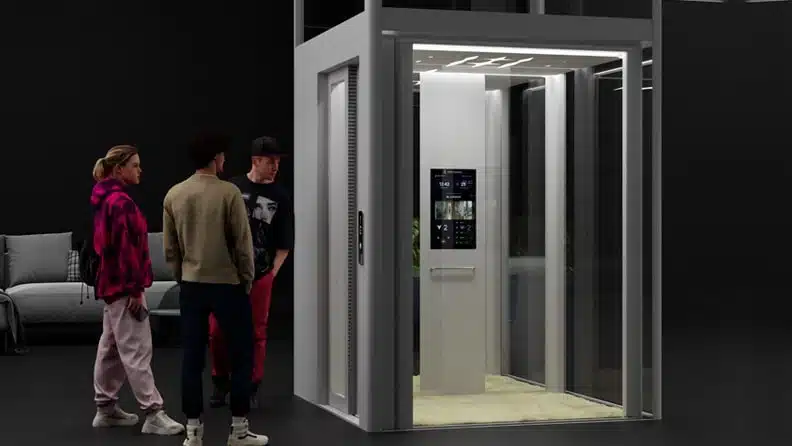
One of the most visible technology trends in 2026’s smart home elevator category is the transformation of the cabin interior from a passive transport space into an active, connected environment — and the Live Board, a 21-inch interactive touch display integrated into the X400 Mark II cabin, is the clearest expression of this trend.
The Live Board delivers real-time news updates, local weather information, personalised screensavers and wallpapers, interactive mini-games, and a family noticeboard feature that allows household members to leave notes for each other — making the cabin a genuinely useful space rather than simply a mode of vertical transport. The display also functions as the lift’s primary control interface, replacing conventional button panels with an intuitive touchscreen that handles all cabin functions including lighting, fan speed, and door timing.
Mobile app connectivity extends the Live Board concept beyond the cabin itself. The Elite Elevators Malaysia smartphone app for the X400 Plus and X400 Mark II allows homeowners to adjust cabin settings, change performance modes, set floor access restrictions, configure custom announcements, and monitor lift status from anywhere with a mobile data connection. The integration between the cabin display and the mobile app creates a coherent connected experience that feels genuinely part of the smart home ecosystem rather than a standalone device.
Remote Diagnostics and Predictive Maintenance: Smart Technology That Protects Your Investment
Among the 2026 smart home elevator technology trends that deliver the most tangible long-term value — but that receive the least attention in product marketing — is remote diagnostics and predictive maintenance capability.
Available across the X400 range, remote diagnostics connects the lift to Elite Elevators Malaysia’s engineering support network, enabling continuous real-time monitoring of motor performance, drive system metrics, door sensor readings, and control system behaviour. The system identifies developing anomalies — changes in performance parameters that indicate a component is beginning to experience stress — often well before they manifest as noticeable faults or failures.
The practical value of this capability is substantial. Instead of waiting for a fault to occur and then scheduling an emergency service visit, Elite’s engineers can proactively contact the homeowner, explain what the diagnostic data shows, and schedule a targeted maintenance visit to address the issue before it becomes a problem. The result is fewer unexpected breakdowns, lower total maintenance costs over the elevator’s lifetime, and a more consistently reliable ownership experience.
Automatic remote software updates complement the diagnostics capability by ensuring the lift’s control firmware is always current — delivering performance improvements, safety enhancements, and new features automatically, without requiring a technician visit or any action from the homeowner. This over-the-air update model, borrowed from the smartphone industry, keeps a 2026 smart home elevator current throughout its operational life in a way that earlier generations of residential lifts simply could not.
Live SOS 2.0 and Next-Generation Emergency Communication
Emergency communication in smart home elevators has also advanced significantly in 2026. The conventional approach — a simple intercom button inside the cabin that connects to a monitoring centre — has been superseded in Elite Elevators Malaysia’s advanced range by Live SOS 2.0, a system that fundamentally reimagines what emergency assistance means in a residential lift context.
Live SOS 2.0 does not wait for a passenger to press a button. When the system detects an emergency condition — through sensor data, fault detection, or a direct activation — it automatically contacts Elite Elevators Malaysia’s support team with the lift’s location, current operational status, and comprehensive diagnostic data. The support team receives a complete picture of the situation before making contact with the passenger, enabling a faster, better-informed emergency response.
For Malaysian and Indian families with elderly family members who use the lift independently, Live SOS 2.0 represents a meaningful advance in the level of safety assurance that a smart home elevator can provide. The combination of proactive emergency detection, instant support team notification, and VisionLog cabin camera monitoring creates a safety net that genuinely changes the risk profile of independent elderly elevator use.
Frequently Asked Questions
1. What makes a home elevator ‘smart’ in 2026?
A genuinely smart home elevator in 2026 goes well beyond basic app connectivity. The defining features are AI destination prediction, biometric access control, remote diagnostics with predictive maintenance, interactive cabin displays, mobile app integration, and proactive emergency communication — all working together as a coherent intelligent system rather than isolated features.
2. Can smart home elevator features be added to an existing lift?
Most smart features in 2026’s leading home elevators — AI, biometric access, VisionLog cameras, Live Board displays — are integrated into the elevator’s core architecture during manufacturing. They cannot be meaningfully retrofitted to older systems. If smart features are a priority, the right approach is to specify them in a new installation rather than attempting to upgrade an existing lift.
3. Is a smart home elevator more expensive to maintain than a conventional one?
In practice, smart home elevators with remote diagnostics capability often have lower total maintenance costs than conventional alternatives — because proactive issue identification and resolution reduces the frequency and severity of reactive repairs. Automatic software updates also eliminate the cost of technician visits for firmware maintenance.
4. Which Elite Elevators Malaysia model has the most advanced smart features?
The X400 Mark II is Elite Elevators Malaysia’s most technologically advanced smart home elevator, integrating Elite AI destination prediction, biometric fingerprint access, VisionLog wide-angle cabin camera with facial recognition, 21-inch Live Board interactive display, mobile app control, Live SOS 2.0, remote diagnostics, automatic software updates, and dual EN 81-41 and EN 81-50 European safety certification.
5. Do smart home elevators work during power failures?
Yes. Every Elite Elevators Malaysia smart home elevator includes a battery-operated Automatic Rescue Device that safely moves the cabin to the nearest floor during any power interruption — allowing passengers to exit safely. The Live SOS 2.0 system also maintains emergency communication capability during power interruptions via its independent backup system.
Nur Aina Sofea
The content is straightforward and easy to understand, even for someone new to the topic.
Rayyan Firdaus
Good article with useful insights. It explains several important aspects of residential lift planning.
Nur Amani Izzati
A good article for understanding the important factors involved in selecting a home lift.
Nur Amirah Izzati
Thanks for sharing this guide. The information is practical and helpful for anyone considering a home lift.
Siti Amani
The content is simple, informative, and easy for general readers to understand.
Qistina Nabilah
Very useful read. I found the information relevant and easy to understand.