Skip to main content
  Add Elite Elevators as preferred
Table of Contents
- From Luxury Addition to Everyday Residential Solution — Understanding Residential Lifts Malaysia
- Residential Elevator Technology: Then vs Now
- Residential Lift for Homes: From Functional Box to Designed Feature
- Safety Has Evolved Too
- What the Future of Residential Lifts Looks Like
- Why Choose Elite Elevators Malaysia for Modern Residential Mobility?
- FAQs About Residential Lifts
Finding the right residential lifts Malaysia solution can feel difficult when a Malaysian home has limited space, multiple levels or an existing layout that was never designed for a lift. Homeowners often worry that adding an elevator will mean losing valuable living area, undertaking disruptive construction, or choosing a system that does not suit the property.
Those concerns are understandable because a residential lift is a long-term decision, and the wrong configuration can create unnecessary cost and inconvenience. The good news is that today’s residential lift options are designed with different home sizes, layouts and lifestyles in mind. With the right site assessment and model selection, homeowners can plan vertical mobility around the home instead of redesigning the entire home around the lift.
From Luxury Addition to Everyday Residential Solution — Understanding Residential Lifts Malaysia
For years, the phrase residential elevator suggested a large, expensive installation that belonged mainly in luxury houses. A lift meant a dedicated shaft, significant construction, and a system designed around commercial-building conventions.
The residential lifts Malaysia homeowners can consider today look very different. Modern home lifts are engineered around domestic spaces, with greater attention to footprint, design, installation flexibility, energy use, safety and personalisation.
The evolution has been driven by a simple change in expectation: homeowners no longer want only a machine that moves between floors. They want vertical mobility that fits the architecture and lifestyle of the home.
That shift is particularly relevant in Malaysia, where multi-storey landed homes, villas and duplexes can make vertical movement part of everyday life. A modern lift can now be planned as part of the home’s design rather than treated as an afterthought.
Residential Elevator Technology: Then vs Now
Older lift concepts were often associated with large traction systems, dedicated machinery and substantial structural requirements. Modern residential systems have expanded the technology choices available to homeowners.
Elite Elevators Malaysia’s current range illustrates that evolution. The E200 uses hydraulic technology with a compact residential configuration and Greaseless Rail technology. The E300 uses a patented gearless cogbelt system designed for quiet, energy-efficient movement. The X400 uses a gearless belt drive and reaches up to 1.0 m/s, while the X400 Mark II adds AI-driven features and connected controls.
The change is not simply about speed. It is about matching the drive technology to the residential use case. Homeowners can compare hydraulic chain drive, gearless cogbelt and gearless belt-drive approaches based on space, travel, performance, design and smart functionality.
Modern residential elevators also place more emphasis on the passenger experience. Touch controls, app connectivity, live displays, custom finishes and intelligent access features are increasingly part of the conversation.
Residential Lift for Homes: From Functional Box to Designed Feature
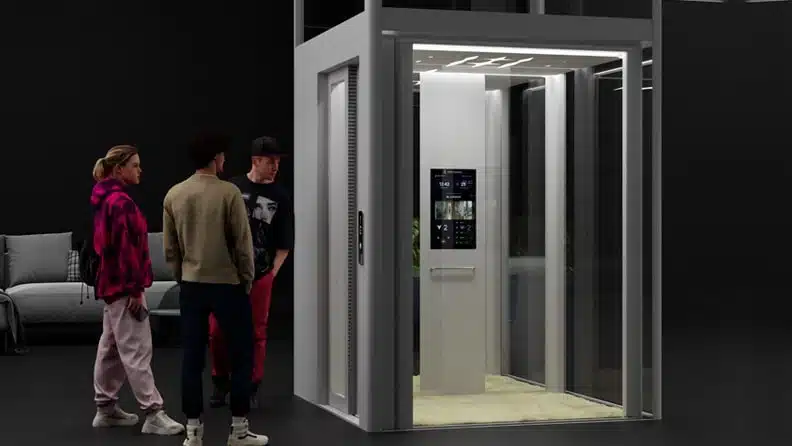
The visual design of a lift has also changed. Traditional elevator cabins often prioritised function over how the equipment interacted with the surrounding architecture. Today’s residential lift for homes can become part of the interior concept.
Elite’s range includes glass cabins, panoramic doors, RAL colour choices, custom wall finishes, flooring options, ceiling designs and other cabin personalisation depending on the model. The E300, for example, supports customisable RAL and glass variants, while the X200 and X200 Plus provide multiple finish options.
The X400 Mark II takes personalisation further through its 21-inch Live Board, custom visual content, mobile app integration and biometric access. These features show how a residential lift can move beyond being a passive transport system and become part of a connected home experience.
For homeowners, this evolution means the question is no longer simply “Where can I put a lift?” It is also “How can the lift belong to the design of my home?”
Safety Has Evolved Too
Safety has always been essential, but modern residential lift design approaches safety through multiple layers rather than relying on one mechanism.
Elite’s models include different combinations of automatic rescue devices, emergency lowering, overload protection, door interlocks or sensors, emergency communication and monitoring systems. The X400 includes five embedded safety layers and EN 81-41 certification. The X400 Mark II is certified to EN 81-20 and EN 81-50 and adds features such as Live SOS 2.0, biometric access and VisionLog camera functionality.
The E200 is certified to EN 81-41 and includes emergency lowering, overload protection, backup for cabin light and fan, door interlocking and anti-crush and anti-fall mechanisms. The E300 includes automatic rescue, emergency stop, overload protection, door interlocking, alarm and intercom.
This layered approach is particularly important in a home because the passenger group is diverse: children, adults, seniors and visitors may all use the lift.
What the Future of Residential Lifts Looks Like
The direction of residential lift technology is clear: more integration, more personalisation and more attention to the realities of existing homes.
The X400 Mark II is a strong example of this next step. Its Elite AI can learn routines and predict destinations; biometric access can control authorised floor access; the cabin camera supports intelligent security functions; the Live Board provides a 21-inch interactive display; and mobile app control allows users to adjust selected functions remotely.
At the same time, the future is not only about adding technology. Simpler models remain important for homeowners who prioritise reliable movement, compact installation and straightforward controls. The X200, X200 Plus, E200 and E300 show that the modern residential market can support different priorities.
In other words, the evolution is not from “old lifts” to “smart lifts” alone. It is from one standard approach to a broader choice of residential mobility systems designed around different homes and families.
Why Choose Elite Elevators Malaysia for Modern Residential Mobility?
Elite Elevators Malaysia’s range reflects the wider evolution of home mobility: hydraulic, cogbelt and gearless belt-drive technologies; compact installation approaches; customisable cabins; and increasingly connected features.
The right model depends on what the homeowner wants to solve. A compact home may prioritise space efficiency. A multigenerational property may prioritise accessibility and safety. A technology-focused homeowner may want AI, biometric access, mobile control and an interactive cabin display. A design-led project may prioritise glass, finishes and colour options.
Rather than selecting a lift solely because it is the newest, homeowners should compare the technical requirements and everyday benefits against the property itself.
A site visit remains the most useful next step because residential lift installation is always influenced by the actual building.
FAQs About Residential Lifts
1. What is a residential elevator?
A residential elevator is a lift designed for private-home use, with equipment, capacity and installation considerations tailored to domestic buildings.
2. How are modern residential lifts different from older lifts?
Modern residential lifts can offer more compact installation, quieter drive technologies, customisable cabins, layered safety systems and smart features.
3. Are residential lifts suitable for existing homes?
Many models are designed with retrofit flexibility in mind, but the actual suitability must be established through a site assessment.
4. Can a residential lift be customised?
Yes. Depending on the model, homeowners may be able to choose cabin finishes, colours, doors, flooring, ceiling designs and smart personalisation features.
5. Which residential lift is best for a home?
The best choice depends on space, number of stops, travel height, capacity, design preferences, installation conditions and desired technology.