 Skip to main content
  Add Elite Elevators as preferred


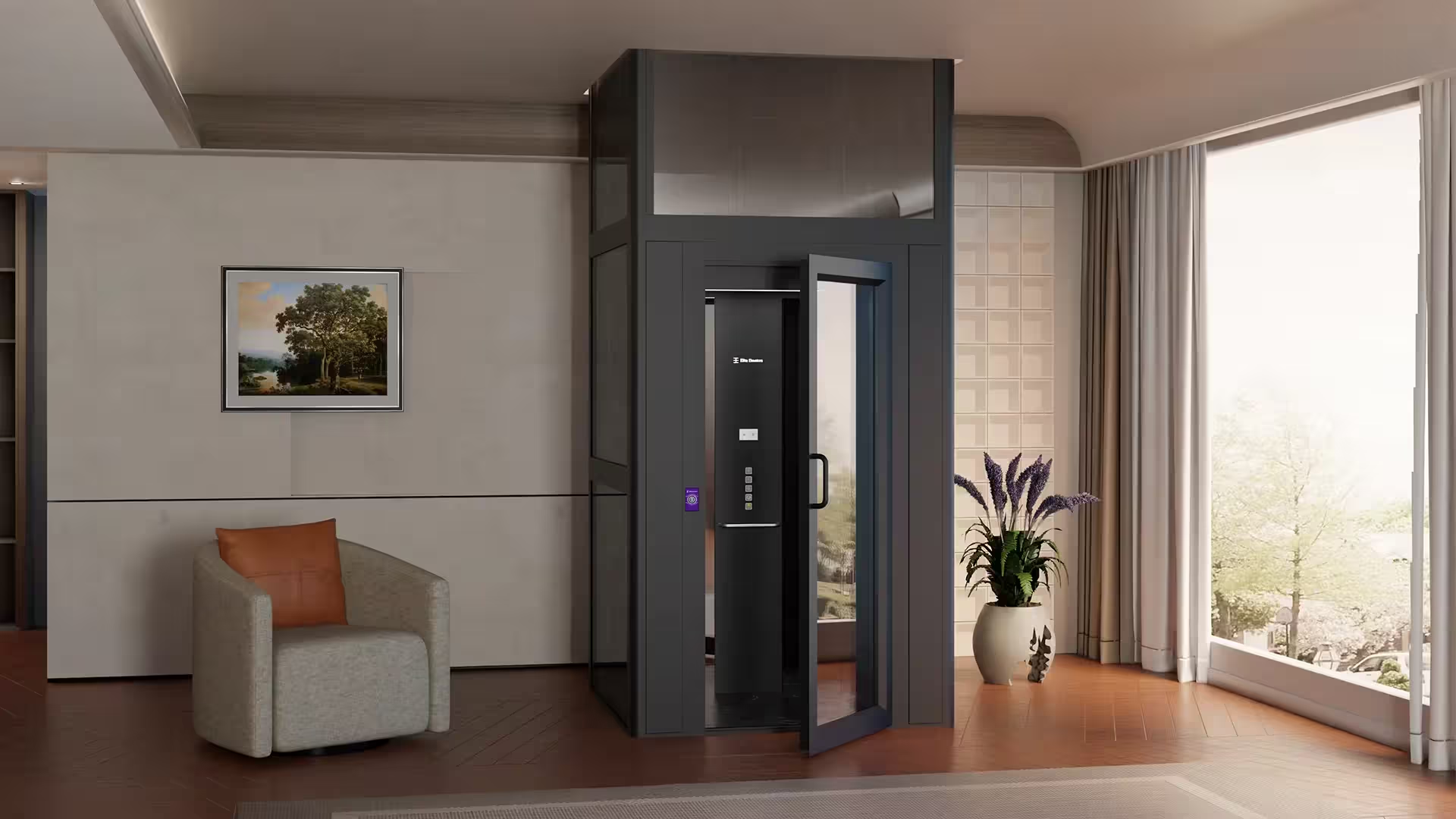
Table of Contents
It usually starts with a moment. Your mother visits for the weekend and you watch her grip the bannister on the way up to the guest room, pausing halfway to catch her breath. Or you come home from a knee procedure and realise that the staircase you have climbed a thousand times now feels like an obstacle course. Or you are designing a new home and your architect casually asks whether you want to future-proof the second-floor connection. In all three cases, the answer is the same: a single-floor home lift.
Yet when most people search for information on this, they find commercial elevator specs or vague articles that never quite answer the core question: what actually is a single-floor home lift, who genuinely needs one, and is it a reasonable investment for a Malaysian home? This guide answers all three — directly, clearly, and without the sales fog.
What Exactly Is a Single-Floor Home Lift?
A single-floor home lift — also called a G+1 lift, a two-stop home elevator, or a residential lift for existing homes — is a compact vertical transportation system that connects two floors of a residential property. It is not a commercial elevator. It is not a hospital-grade accessibility device. It is specifically engineered for private homes where one flight of stairs represents the daily mobility challenge.
In technical terms, a single-floor configuration means the lift has two stops: ground floor and first floor. The travel height is typically between 2.8 and 3.5 metres in a standard Malaysian home. The cabin size, drive system, pit depth, and cabin finish all remain fully flexible — a single-floor lift can be as minimal as a compact hydraulic cabin or as premium as a gearless AI-powered elevator with a 21-inch interactive display. The floor count does not limit the quality of the product. It simply defines the structural configuration.
Who Actually Needs a Single-Floor Home Lift?
The honest answer is: more people than most Malaysian homeowners currently realise. The perception that home lifts are for people with serious disabilities or extreme wealth is outdated and, increasingly, wrong. Here are the real profiles of homeowners who install single-floor lifts — and the real reasons they do it.
Families with Elderly Parents
Multi-generational living is the norm across Malaysia, not the exception. When an elderly parent moves into the upper floor of a child’s home, the staircase becomes a daily safety concern — particularly in Malaysia’s heat and humidity, which make physical exertion more demanding. A single-floor home lift removes that risk entirely. The parent gains independence. The family gains peace of mind. The home becomes genuinely functional for everyone who lives in it.
Post-Surgery and Temporary Mobility Challenges
Knee replacements, hip procedures, spinal surgeries, and sports injuries all share one common inconvenience: stairs become genuinely difficult for weeks or months. Most Malaysian families manage by moving the patient to the ground floor for the recovery period — effectively making an entire floor of the home inaccessible. A single-floor home lift eliminates this compromise. The person recovers comfortably in their own bedroom, on their own floor, on their own schedule.
Young Families with Heavy Daily Loads
Think about what moves between floors in a typical Malaysian home every single day: groceries, laundry, luggage, baby gear, large deliveries. A single-floor lift is not just an accessibility product — it is a practical household convenience that reduces physical strain for every member of the family. The parents who install a lift for their ageing parents often find themselves using it just as frequently for everything else.
Proactive Homeowners Planning for the Future
This is the group that competitors rarely talk about — and the group that makes the smartest financial decision. Installing a single-floor home lift during construction or renovation costs significantly less than retrofitting one into a completed home. Homeowners who are currently 35 or 45 years old and installing now are the ones who will be most grateful in 15 years. The lift that improves the quality of life for elderly parents today becomes the infrastructure that supports the homeowner themselves in the decades ahead.
What Is the Difference Between a Single-Floor Lift and a Multi-Floor Elevator?
Functionally, the core difference is the number of stops and the travel height — which affect rail length, landing door count, and shaft depth. The drive system, safety features, cabin quality, and installation requirements are essentially identical between a G+1 and a G+3 configuration. A single-floor home lift in Malaysia carries the same EN 81-41 certification, the same safety layers, and the same customisation options as a full multi-floor installation.
What this means practically: you are not buying a lesser product when you specify a single-floor configuration. You are buying a full-quality residential elevator with a simpler structural footprint. The cost is lower because less material is used — not because any engineering standard has been reduced.
Do You Need a Pit or Machine Room for a Single-Floor Lift?
This is the practical question that stops most Malaysian homeowners from proceeding — and the answer is reassuring. Elite’s single-floor hydraulic lift options (the X200 and E200) require only a 100 to 120 mm pit — achievable with a simple floor threshold in most completed homes. The X400 and X400 Mark II require no deep pit at all. None of Elite’s home elevator range requires a machine room. The E50 Stairlift requires zero civil work whatsoever — it mounts directly on your existing staircase.
For most double-storey Malaysian homes, a single-floor lift can be installed with 2 to 3 weeks of professional installation time, no wet concrete work, and no structural modification beyond the floor opening at each level. The disruption is far less than most homeowners expect.
What Does a Single-Floor Home Lift Cost in Malaysia?
Pricing depends on the product chosen, the cabin finish selected, and whether the installation is into an existing home or a new build. Elite’s most accessible hydraulic models represent the entry point for a full cabin single-floor installation. The E50 Stairlift is a lower-cost alternative for homes where a full cabin lift is not feasible or necessary.
The most accurate way to understand your cost is through a no-obligation site survey from Elite Elevators Malaysia — where an engineer assesses your specific home, confirms what fits, and provides a transparent, itemised quotation. That conversation is free. The clarity it provides is invaluable.
Frequently Asked Questions
1. Can a single-floor home lift be installed in a completed Malaysian house?
Yes — and this is the most common scenario for Elite Elevators Malaysia’s single-floor installations. Elite’s hydraulic and gearless products require only a shallow pit of 100 to 120 mm and no machine room, making retrofit installation practical in most completed terrace houses, semi-detached homes, and bungalows.
2. Is a single-floor home elevator worth the investment?
For households with elderly family members, any mobility challenge, or a lifestyle that involves heavy daily movement between floors, the daily quality-of-life improvement makes the investment compelling from day one. Homes with lifts also command higher resale values in Malaysia’s growing accessible-home market. And for proactive homeowners installing during construction, the cost is significantly lower than a future retrofit — making early investment the clearly superior financial decision.
3. What is the smallest home lift size available in Malaysia?
Elite Elevators Malaysia offers compact home lift models suitable for homes with limited space. Models like the E200 are designed to fit into smaller layouts without major structural changes. The final lift size depends on your available space, and the team will recommend the right configuration after a site survey.
4. Does a single-floor home lift require planning permission in Malaysia?
For most private landed residential properties, a home lift installed within the structure does not require a separate building permit beyond standard electrical works. For condominiums and strata properties, management corporation approval is typically required. Elite Elevators Malaysia’s team advises on all relevant approvals for your specific property type.
5. How long does a single-floor home lift last?
A well-maintained Elite home elevator has a working life of 15 to 20 years. Annual professional servicing maintains performance and safety standards throughout this period. Elite’s Greaseless Rail technology on the E200 and remote diagnostics on smart models reduce the frequency and cost of maintenance interventions, making Elite lifts among the lowest-maintenance residential elevators available in Malaysia.
Find Your Perfect Lift — The Full Elite Elevators Malaysia Range
Every home is different. Every family is different. Elite Elevators Malaysia has a certified, customisable home lift built for yours.
- X400 — Gearless belt drive, 1.0 m/s, world-largest glass cabin, 4 modes
- X400 Mark II — AI-powered, biometric, 21″ Live Board, VisionLog camera
- X200 — Premium hydraulic, panoramic glass, 16 RAL colours
- X200 Plus — Smart hydraulic, app control, biometric, Live SOS
- E200 — Greaseless Rails, zero lubrication, single-phase power
- E300 — Cogbelt gearless, whisper-quiet, 0.40 m/s
- E50 Stairlift — No shaft, fits all staircases
Nur Amani Sofea
I appreciate the clear and practical approach used in this article.
Fawwaz Iskandar
Very useful article with practical information. It helped me understand the key points to consider when planning a home lift.
Amir Hakimi
A helpful article with practical information about planning and selecting a home elevator.
Tengku Faris
Helpful and informative content. I found the practical considerations particularly useful when thinking about a residential lift.
Arman Hakimi
Interesting content with useful information. It is a good reference when researching residential lift options.
Aiman Hakim Zulkifli
Good resource for homeowners who want to learn more about residential elevator options.