Skip to main content
  Add Elite Elevators as preferred
Table of Contents
- Why Staircases Become a Problem Before Anyone Admits It
- What an Elevator for Elderly Family Members Actually Needs to Do
- The Comfort Mode Difference
- Elite’s Range for Elderly Passengers
- Future-Proofing: Why Installing Now Costs Less Than Installing Later
- Frequently Asked Questions
- 1. At what age should a family consider installing a home elevator for elderly parents?
- 2. Which elevator is easiest for an elderly person to operate independently?
- 3. Is a home lift for elderly parents covered by any Malaysian government scheme?
- 4. What happens if an elderly person gets stuck in the elevator during a power cut?
- 5. How smooth is the ride quality in home lifts for seniors?
There is a particular kind of guilt that settles in slowly. You watch your father pause midway up the stairs, hand on the rail, catching his breath. You watch your mother choose not to come downstairs for dinner because the climb back up is not worth it. These are not dramatic moments. They are quiet ones — and they accumulate into a household that has quietly stopped working for one of the people who lives in it.
A home lift for elderly parents does not solve ageing. But it does something profound: it gives back access. It restores the floors of the home. It returns independence. And for the adult children who worry, it removes the daily anxiety that a staircase represents. This guide explains what to look for, what genuinely matters, and which home lifts for seniors make the most sense in a Malaysian multi-storey home.
Why Staircases Become a Problem Before Anyone Admits It
The transition from ‘stairs are manageable’ to ‘stairs are a barrier’ rarely announces itself. It happens gradually — more care on the way down, more rest on the way up, certain floors avoided during the day and only visited when necessary. By the time the family recognises the staircase as a safety concern, it has usually already been limiting the elderly person’s movement for months.
In Malaysian multi-generational households, where grandparents often live on upper floors and family activity is concentrated downstairs, this pattern isolates elderly family members within their own home. They are physically present but functionally separated by a flight of stairs. A home lift for elderly parents reconnects those floors — without requiring the elderly person to ask for help, without requiring a family member to always be present, and without requiring any modification to how the rest of the household lives.
What an Elevator for Elderly Family Members Actually Needs to Do
The design brief for a home elevator for seniors is specific. It is not the same as a general home elevator brief with ‘elderly-friendly features’ added. The core requirements are:
- Smooth, predictable travel — no jerk at departure, no abrupt stop at landing. Elderly passengers are more sensitive to sudden movement and more likely to lose balance during unstable cabin motion. Hydraulic and gearless drive systems that are calibrated for residential comfort deliver this naturally.
- Consistent floor levelling — a cabin that arrives slightly misaligned with the landing creates a step that is genuinely dangerous for an elderly passenger stepping in or out. Auto re-levelling, standard on Elite’s X200 Plus and X400 range, eliminates this risk.
- Easy-to-operate controls — panels positioned at accessible heights, buttons that are clear and responsive, and on the X400 Mark II, biometric fingerprint access that requires only a fingertip press rather than button navigation.
- Reliability under light daily use — home lifts for seniors are used gently but consistently. The drive system must perform reliably on this low-intensity, high-frequency pattern without the degradation that would occur if it were sized too close to its operational limits.
- Safety systems that act for the passenger — the ARD on all Elite models automatically lowers the cabin to the nearest floor during a power outage and opens the doors, allowing the passenger to exit without any manual action. Live SOS on the X400 Mark II alerts Elite’s support team automatically.
The Comfort Mode Difference
Elite’s X400 and X400 Mark II include a Comfort Mode performance setting specifically calibrated for unhurried, smooth travel. In Comfort Mode, the cabin door opens automatically at each floor and remains open during standby, the lighting stays at full brightness throughout the journey, and the travel speed is adjusted for a relaxed, unhurried pace. Elderly passengers never need to manage the mode — it can be set as the default by the household and stays that way.
This kind of thoughtful engineering is the difference between a home elevator for seniors and an elevator that tolerates elderly passengers. The design was made with this specific use case in mind.
The Conversation No Family Wants to Have
Many Malaysian families delay installing a home lift for elderly parents because the conversation around it feels like an acknowledgement of decline. Raising the topic can feel like telling a parent they are no longer capable — which is not the intention and is rarely how the parent experiences the lift once it is installed.
The families who install early — before the staircase becomes a genuine safety risk — consistently report that the elderly family member uses the lift more enthusiastically and more frequently than anyone expected. It is not experienced as a medical accommodation. It is experienced as a convenience that everyone in the household uses. The lift that was installed ‘for Mum’ becomes the lift that everyone takes.
Elite’s Range for Elderly Passengers
Every Elite home elevator is designed with multi-generational use in mind. Here is how the range serves elderly passengers specifically:
- E50 Stairlift — for homes where a full cabin elevator is not feasible. Mounts on existing stairs, zero civil works, specifically designed for elderly and limited-mobility users. ASL technology delivers the smoothest stairlift ride available.
- E200 — low-maintenance hydraulic with single-phase power and patented Greaseless Rail technology. Quiet, clean, consistent. For elderly parents who value a lift that simply works without any household drama around it.
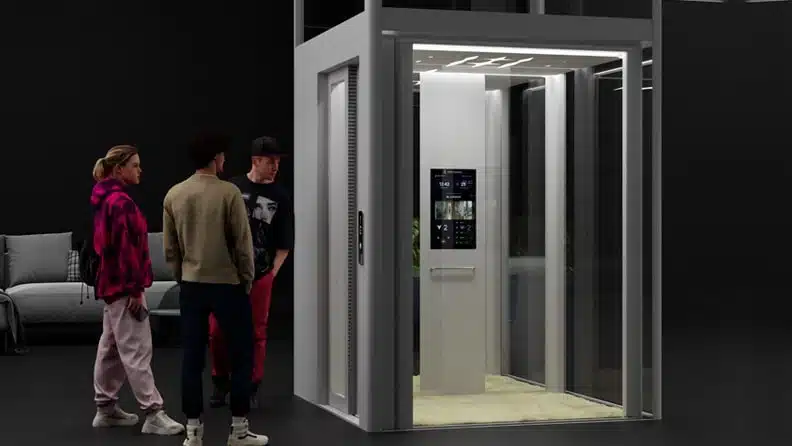
- X200 Plus — biometric access, auto re-levelling, Live SOS, and a 21-inch cabin display that shows time, weather, and family notes. The smart hydraulic choice for families who want to stay connected to an elderly parent’s daily movements.
- X400 Mark II — AI that learns the elderly user’s routine and prepares the lift without any button-pressing required. Biometric and voice-command access. VisionLog camera for family monitoring. The most effortless experience available for home elevators for seniors.
Future-Proofing: Why Installing Now Costs Less Than Installing Later
The cost of installing a home lift for elderly parents during a renovation or new build is significantly lower than retrofitting one into a completed home. Floor openings are easier to incorporate during construction. Shaft placement can be optimised from the outset. Electrical provision can be planned in advance. Families who recognise the staircase as a future concern — even if it is not a current crisis — save substantially by acting during a construction or renovation phase rather than after.
If your home is already completed, Elite’s no-deep-pit, no-machine-room products (X400, X400 Mark II, X200, X200 Plus, E200, E300) are designed specifically for retrofit installation with minimal civil works. Most completed Malaysian terrace houses and bungalows can be fitted within 2 to 3 weeks.
Frequently Asked Questions
1. At what age should a family consider installing a home elevator for elderly parents?
There is no specific age threshold — the relevant indicator is whether the staircase is beginning to limit movement or cause concern. Many Malaysian families install home lifts for seniors while the elderly parent is still fully mobile, precisely because installation during this period is less disruptive and often incorporated into a renovation. The best time to install is before the staircase becomes a safety issue, not after.
2. Which elevator is easiest for an elderly person to operate independently?
The X400 Mark II’s Elite AI and biometric fingerprint access make it the most effortless elevator for elderly independent use — the lift anticipates the routine and responds to a fingerprint without any button navigation. For homes where a full cabin elevator is not feasible, the E50 Stairlift is purpose-designed for elderly users with a simple seat-mounted control and zero civil works installation.
3. Is a home lift for elderly parents covered by any Malaysian government scheme?
As of 2025, there is no specific Malaysian federal subsidy for residential home lifts. However, certain state-level accessibility programmes may offer support for permanent residents with mobility disabilities. Elite Elevators Malaysia’s consultants can advise on any relevant programmes based on your specific location and household situation during the consultation.
4. What happens if an elderly person gets stuck in the elevator during a power cut?
Every Elite home elevator is equipped with a battery-operated Automatic Rescue Device (ARD) that immediately lowers the cabin to the nearest floor and opens the doors during any power interruption — without requiring any action from the passenger. The X400 Mark II and X200 Plus additionally trigger a Live SOS alert to Elite’s support team automatically. An elderly passenger in an Elite elevator is never stranded.
5. How smooth is the ride quality in home lifts for seniors?
Elite’s hydraulic and gearless drive systems are calibrated specifically for residential comfort — smooth departure, consistent mid-travel speed, and a precise, level stop at each floor. The X400 and X400 Mark II’s Comfort Mode further reduces travel speed and keeps the cabin lit and door-ready throughout. The ride is deliberately unhurried and completely predictable — exactly what elderly passengers need.