Skip to main content
  Add Elite Elevators as preferred


Table of Contents
- What Are The Factors To Consider Before Purchasing A Home Lift In Malaysia?
- What Are The Pros and Cons Of An Indoor Lift For Homes?
- What Are The Pros And Cons Of An Outdoor Household Elevator?
- What Are The Specifications Of Elite Elevators With Respect To Installation Environment?
- How Do Elite Elevators Engineer A Home Lift In Malaysia?
- Frequently Asked Questions
An indoor lift is a residential elevator designed to provide convenient movement between floors while integrating into the interior layout of a property. It can be a solution for multi-storey homes, particularly for families looking to improve convenience and long-term mobility. Elite Elevators offers residential elevator solutions designed for different home configurations, with options that can be customised.
When planning a home lift, one of the first decisions is where it should be installed. An indoor lift can integrate neatly with the home’s existing layout, but limited floor space may make an external installation more practical. For homeowners considering a lift for homes, the choice between indoor and outdoor placement can affect accessibility, aesthetics, construction requirements and long-term maintenance.
An indoor lift can offer convenient access while being protected from outdoor weather conditions, but finding enough space within an existing home can be challenging. An external household elevator, on the other hand, may preserve valuable interior space but requires careful consideration of weather exposure, structural support and access to each floor.
For homeowners researching a home lift Malaysia solution, understanding these advantages and limitations is essential before selecting an installation location. This guide compares indoor and outdoor home lift installations, helping you evaluate which approach better suits your home’s structure, available space and everyday requirements.
What Are The Factors To Consider Before Purchasing A Home Lift In Malaysia?
In a temperate climate, outdoor placement is mostly a cost conversation. Here, it’s materials and detailed conversation. Three local factors drive the decision:
Plot size: Terrace and semi-detached homes across Klang Valley have little internal area to spare. Losing roughly 4.5 to 5 feet of clear floor space on every level — the typical footprint for a lift for homes — is a real sacrifice when the living room is already tight.
Rain and humidity: An external shaft needs genuine water management, not sealant applied on site. Elite Elevators’ patented metallic shaft uses no rivets and no silicon; all four sides are clad in steel or glass panels with a purpose-made gasket system, and the top and bottom panels on the guide side carry round axial aerators for ventilation.
Retrofit reality: Most Malaysian lift enquiries are for completed homes, not new builds. That single fact pushes many households toward an outdoor shaft — and it’s usually the right call.
What Are The Pros and Cons Of An Indoor Lift For Homes?
An indoor lift sits inside the building envelope: beside the staircase, within a stairwell void, or in a corner that stacks cleanly from ground to top floor.
What you gain
- Weather is a non-issue: No rain loading, no UV on finishes, no wind-blown debris. Panel and cabin choices are made purely on looks.
- Lower headroom demand: An indoor installation is structurally kinder at the top of the shaft. The E200 in an existing concrete shaft requires a shaft top height of just 2300 mm with a doorless cabin; with its own metal shaft and indoor flat roof, 2470 mm. The outdoor equivalent, which needs an inclined roof to shed rain, rises to 2490 mm.
- Genuinely shallow pits: The X400 Mark Ⅱ needs only 59 mm without a shaft (100 mm with one), the X200 100 mm, the E200 approximately 120 mm, and the E300 140 mm — with no pit at all where a threshold or ramp is used. No machine room is required on any model.
- Dignified, sheltered access: For seniors, wheelchair users or anyone carrying a child at 2am, not crossing a wet porch is worth more than any specification.
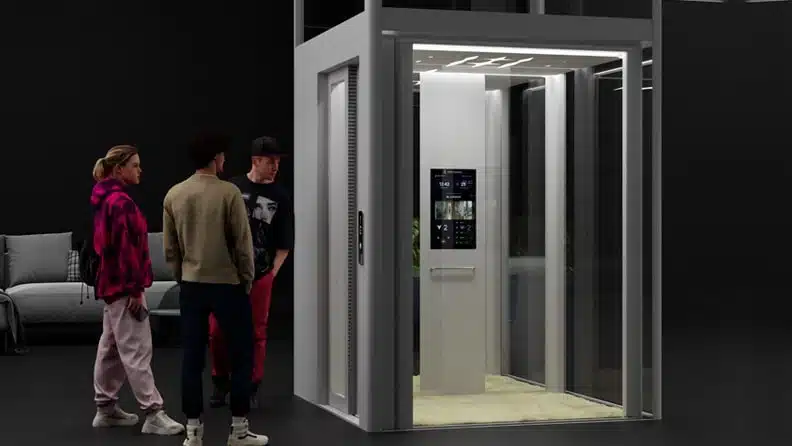
- It reads as architecture: A full glass cabin — up to 1500 mm × 1500 mm on the X400 XL — becomes the visual centrepiece of a double-height void rather than a utility.
What it costs you
- Permanent loss of internal floor area on every level.
- Higher retrofit disruption: vertically aligned slab openings mean dust, rooms out of use and tight contractor coordination.
- Constrained siting — a beam or column in the wrong place can eliminate an otherwise perfect corner.
What Are The Pros And Cons Of An Outdoor Household Elevator?
An outdoor installation ties the shaft to an external wall, an air well or a balcony line, with landing doors opening inward at each level.
What will you gain:
- Zero internal space lost. For compact plots, this alone settles the argument.
- Dramatically simpler retrofitting. The E200 and E300 can be supplied with their own patented self-supporting metallic shaft, eliminating the need for a separate concrete, brick or fabricated structure. The bulk of the work happens outside; the household carries on inside.
- Engineered weatherproofing. Gasketed panels, inclined roof and integrated aerators are designed for this application — and the structure is verifiable for seismic conditions under Eurocode with unit-specific fixing calculations.
- Views on every ride. Panoramic glass shaft cladding plus half or full panoramic cabin walls turn a functional trip into a pleasant one.
- Greaseless rails matter more outdoors. The E200’s patented Greaseless Rail (GLR) technology means greaseless anywhere on the guide system — nothing for airborne dust or coastal grit to cling to.
What Are The Specifications Of Elite Elevators With Respect To Installation Environment?
| Specification | E200 | E300 CogBelt | X200 / X200 Plus | X400 Mark II |
| Drive system | Hydraulic control unit, indirect action by chains | Patented gearless cog-belt | Hydraulic chain drive | Gearless belt drive |
| Rated speed | 0.15 – 0.3 m/s | 0.15 – 0.4 m/s | Up to 0.30 m/s | Up to 1.0 m/s |
| Rated load | Up to 400 kg | Up to 400 kg | 400 kg | 440 kg |
| Travel height | 12,600 – 13,100 mm | Up to 18,000 mm | Up to G+4 levels | Up to 21,000 mm |
| Stops | Max 6 stops | Max 6 stops | Up to 4 stops | Up to G+5 |
| Doors | Max 12 doors | Max 12 doors | 600 – 900 mm manual swing | Max 12 doors |
How Do Elite Elevators Engineer A Home Lift In Malaysia?
The reason placement is a preference rather than a compromise comes down to certification and drive engineering.
Safety Certified: The E Series complies with the European Machinery Directive 2006/42/EC and EN 81-41. Crucially, it sits separately from the overspeed governor, so a mechanical fault elsewhere cannot compromise it. The X400 Mark Ⅱ additionally meets EN 81-20 and EN 81-50, with a reinforced 5-layer safety framework, dual emergency braking and Live SOS 2.0.
Planned Power cuts: Battery-operated emergency lowering brings the cabin to a floor where passengers exit safely, backed by cabin light and fan backup, GSM-enabled emergency calling and an Automatic Rescue Device across the range.
Drive systems Vs travel height: The E200 runs a hydraulic control unit with indirect chain action at 0.15–0.3 m/s, 400 kg, 12,600–13,100 mm travel, max 6 stops and 12 doors, on 24 V control and single-phase supply — consuming roughly what a half-ton air conditioner does. The E300’s patented gearless CogBelt reaches 0.4 m/s and 18,000 mm travel. The X400 Mark Ⅱ steps up to a gearless belt drive at 1.0 m/s, 440 kg, up to 21,000 mm travel and 12 doors.
Matching model to site: Compact outdoor retrofits suit the X200 / X200 Plus (0.30 m/s, 400 kg, up to G+4, 100 mm pit, 2300 mm headroom, panoramic glass swing doors); tall villas suit the E300; homes wanting speed and smart control suit the X400 Mark Ⅱ with biometric access, 21-inch Live Board and 16 RAL colours; and where no shaft is possible at all, the E50 stairlift fits staircases as narrow as 610 mm at inclines to 72°, carrying 125 kg on battery power, certified to EN 81-40.
Frequently Asked Questions
-
Can a home lift be installed outdoors in Malaysia?
Yes. Elite Elevators models including the E200, E300, X200, X200 Plus and X400 Mark Ⅱ are rated for indoor and outdoor environments. Outdoor units use a patented metallic shaft with gasketed steel or glass cladding, an inclined roof and integrated aerators, and the structure contains no rivets or silicon.
-
Does a home lift need a machine room or a deep pit?
No Elite Elevators home lift requires a machine room. Pit depths are shallow: 59 mm for the X400 Mark Ⅱ without a shaft, 100 mm for the X200, approximately 120 mm for the E200 and 140 mm for the E300 — with no deep pit needed where a threshold or ramp is provided.
-
How much space does a lift for homes need?
Around 4.5 to 5 feet of clear footprint, varying with cabin size. Standard cabins run 1400 × 1200 mm on the X200 Plus and 1200 × 1200 mm on the X400 Mark Ⅱ, with an XL option of 1500 × 1500 mm. The E200 comes in eight standard sizes or custom dimensions.
-
How long does installation take?
An Elite Elevators E200 typically takes 3–5 weeks to install with minimal civil work, especially when a self-supporting shaft removes the need for concrete construction. The E50 stairlift is usually completed in one to three days.
-
Will an outdoor lift still work during a power failure?
Yes. Battery-operated emergency lowering and an Automatic Rescue Device bring the cabin to the nearest floor for safe exit, with GSM emergency calling and cabin light backup remaining active. The X400 Mark Ⅱ from Elite Elevators adds Live SOS 2.0 for real-time assistance.